

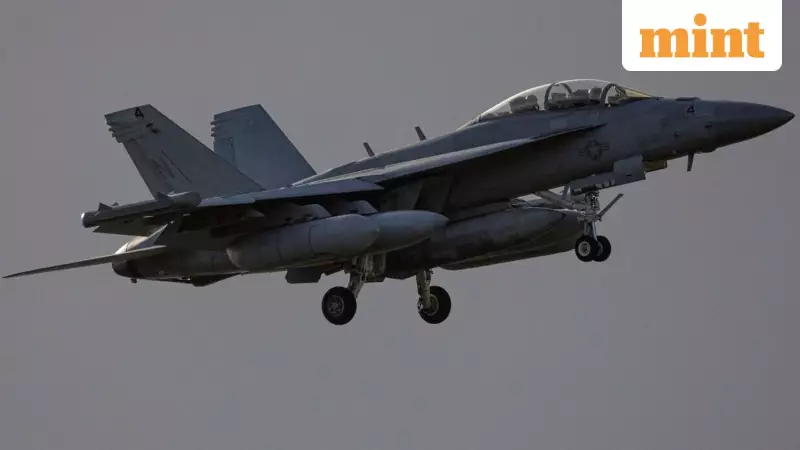
In a dramatic military operation over the past weekend, the United States deployed a formidable array of air power to Venezuela. Among the more than 150 warplanes was a specialist aircraft that attacks signals, not people: the Boeing EA-18G Growler. This electronic warfare jet is credited with a crucial role in swiftly overwhelming Venezuela's air defenses, enabling special forces to seize the country's president, Nicolás Maduro.
The Growler's Pivotal Role in the Venezuela Operation
Flown by a Navy squadron nicknamed the "Zappers," the Growler is based on the F/A-18F Super Hornet and is a stalwart of U.S. electronic warfare (EW). According to Thomas Withington, an EW expert at the Royal United Services Institute think tank, the aircraft would have located Venezuelan radars, jammed them, and performed similar tasks with military communications. The operation, which also included F-22s, F-35s, B-1 bombers, and drones, successfully suppressed Venezuelan air defense and communications networks.
The U.S. faced a less sophisticated adversary in Venezuela. The country's air defenses, while decent, were limited and aging, predominantly consisting of Soviet- and Russian-made systems. For instance, Venezuela possessed about 12 S-300 missile-defense systems, versions of which were also easily bypassed by Israel's air force in previous conflicts. Some older Chinese radar models were also in the inventory, as noted by defense-intelligence company Janes.

The Renaissance of Electronic Warfare
Electronic warfare, which involves targeting or protecting communication, radar, and other signals, is experiencing a major revival. After being somewhat neglected post-Cold War and in recent Middle Eastern conflicts, the Ukraine war has underscored its critical importance. The conflict is widely considered history's largest electronic-warfare battleground, where the mass use of drones has created new opportunities for jamming and spoofing signals.
Frank Kendall, former U.S. Air Force secretary, emphasized that while EW is less visible than fighter jets or ships, it is critically important. "EW is not as well understood by people, and it is not as visible or catchy as buying fighter planes or ships," he said. "But it is critically important as we have seen in Ukraine." Russia has developed particular expertise, even jamming advanced U.S. systems like the HIMARS rocket artillery.
Capabilities, Cost, and Global Competition
The Growler, first delivered in 2008 and priced around $67 million in 2021, is packed with EW equipment carried in large pods under its wings and belly. It has a two-person crew, including an EW specialist. Its toolkit goes beyond simple jamming; it can sample an enemy radar's pulse and send it back to simulate multiple aircraft, creating confusion. It also carries anti-radiation missiles designed to detect and destroy adversary radars.
This resurgence has made electronic warfare one of the defense industry's most lucrative sectors. European companies report high margins in this field, marketing products like missiles that scramble communications and decoys that emit confusing signals. To counter jamming, militaries are exploring laser communications and even reverting to fiber-optic cables for drones, as seen in Ukraine.
However, analysts express concern that the U.S. and Europe may be falling behind, particularly China. Updates to the Growler's essential EW pods have been delayed, with Kendall noting, "Progress in the program has been painfully slow." As artificial intelligence opens new frontiers in EW, the race for dominance in this invisible domain is intensifying, proving that modern warfare is as much about controlling the spectrum as it is about controlling the skies.






