

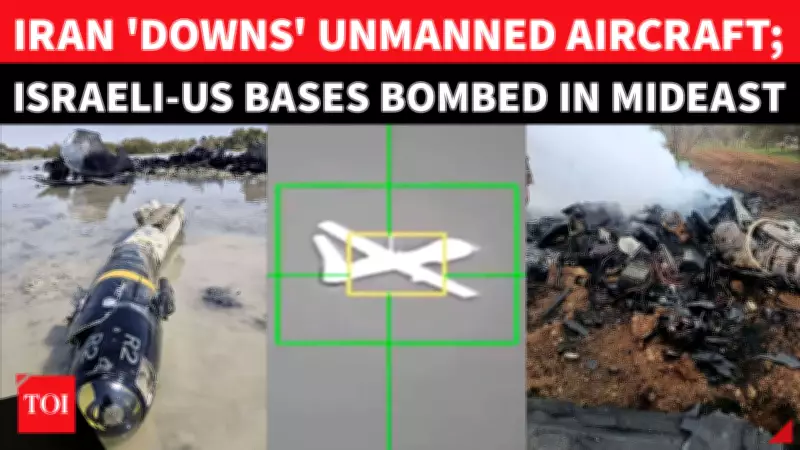
Iran's Revolutionary Guard Escalates Conflict with Major Missile Strikes
The volatile situation in the Middle East has taken a perilous turn as the Islamic Revolutionary Guard Corps (IRGC) of Iran has initiated a significant new wave of military operations. According to official statements from Tehran, the IRGC has launched what it describes as the 48th wave of Operation True Promise 4, targeting both United States and Israeli military assets across the region.
Missile Barrage Targets Strategic Locations
Iranian military forces reportedly deployed advanced ballistic missiles, including the formidable Kheibar Shekan and Qadr systems, in coordinated strikes. These precision-guided weapons were aimed at multiple high-value targets. Israeli military infrastructure in Be'er Sheva was specifically mentioned as a primary objective, along with broader attacks across the Galilee region, the Golan Heights, and the coastal city of Haifa.
Furthermore, the IRGC claims to have successfully struck the Al Udeid Air Base in Qatar, a critical operational hub for US forces in the Middle East. This base serves as a forward headquarters for the United States Central Command and hosts thousands of American military personnel, making it a strategically significant target in any regional confrontation.

Iranian Air Defenses Engage Multiple Drones
Simultaneously, Iran's integrated air defense network was activated to counter aerial threats. Iranian authorities reported that their systems successfully intercepted and destroyed several unmanned aerial vehicles (UAVs) entering Iranian airspace. An MQ-9 Reaper drone was shot down near the strategic port city of Bandar Abbas on the Persian Gulf coast, while a Hermes-type surveillance drone was eliminated near Andimeshk in southwestern Iran.
These engagements demonstrate Iran's continued investment in and capability of its multi-layered air defense architecture, which includes both domestically produced systems and adapted foreign technology. The downing of sophisticated drones represents a clear message about Iran's ability to defend its territorial integrity against aerial incursions.
Coordinated Operations with Regional Allies
The IRGC operations were reportedly conducted in close coordination with Hezbollah, the Lebanese militant group and political party that maintains strong ties with Tehran. This collaboration underscores the expansive network of alliances that Iran has cultivated across the region, allowing for synchronized military actions against common adversaries.
Such coordinated strikes represent an escalation in the proxy warfare dynamics that have characterized the Middle East for years, potentially drawing multiple state and non-state actors into direct confrontation.
Dangerous Escalation in Regional Tensions
These developments mark one of the most serious escalations in the ongoing triangular confrontation involving Iran, the United States, and Israel. The direct targeting of American military bases and Israeli territory with advanced missile systems represents a qualitative shift from previous engagements, which often involved proxy forces or limited strikes.
The situation remains fluid and highly volatile, with the potential for rapid escalation into broader regional conflict. Military analysts are closely monitoring responses from Washington and Jerusalem, as any significant retaliation could trigger a dangerous cycle of action and counteraction with unpredictable consequences for regional stability.
This latest wave of hostilities follows months of increasing tensions and periodic clashes, suggesting that the underlying geopolitical fault lines in the Middle East are becoming increasingly difficult to manage through diplomatic channels alone.






