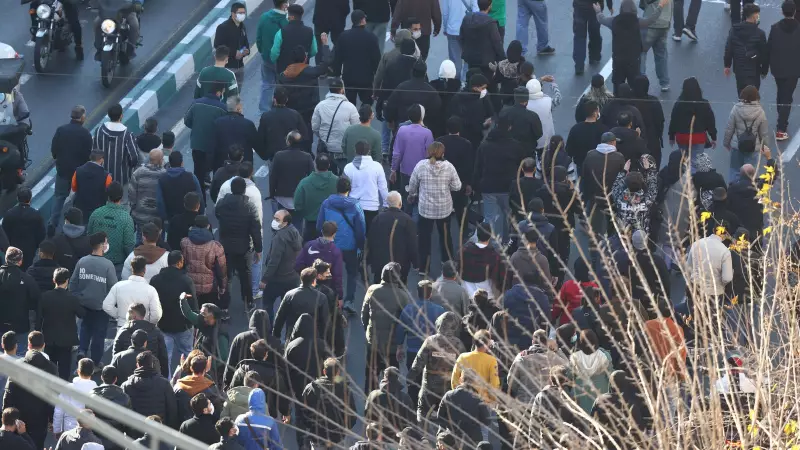
Iran is witnessing its most significant wave of public unrest in three years, with protests triggered by a severe economic crisis escalating into violent and deadly clashes with security forces. What began as demonstrations by shopkeepers and traders over the government's handling of a collapsing currency and skyrocketing prices has now spread across several cities, posing a fresh challenge to the country's clerical leadership.
Economic Despair Fuels Widespread Unrest
The protests ignited on Sunday, initially led by shopkeepers and traders furious at the state's inability to control a sharp economic downturn. The core grievances are a plummeting national currency and rampant inflation. Reports indicate Iran is grappling with an inflation rate exceeding 40%, while the Iranian rial has lost about half of its value against the US dollar in 2025 alone.
This economic distress, exacerbated by years of stringent US and Western sanctions linked to Iran's nuclear programme, has pushed merchants, shop owners, and students into the streets for consecutive days. In a powerful show of dissent, major bazaars have shut down in protest, bringing commercial life to a halt in several urban centres.

Violence Erupts, Casualties Reported in Multiple Cities
The peaceful economic demonstrations have rapidly spiralled into violence. According to Iranian media and international rights groups, overnight unrest into Thursday turned deadly in multiple regions.
In Lordegan, a city in western Iran, the semi-official Fars news agency reported that two people were killed in clashes between security services and what it termed "armed protesters." The rights group Hengaw, however, stated that several individuals were killed and wounded in the same city by security forces.
Authorities confirmed one death in the western city of Kuhdasht. The Revolutionary Guards stated that one member of its Basij volunteer paramilitary unit, identified as Amirhossam Khodayari Fard, was killed and 13 others wounded. They blamed demonstrators who "took advantage of the protests." Contradicting this, Hengaw reported that the deceased was himself a protester killed by security forces.
Further violence was reported in the central province of Isfahan, where Hengaw said a protester was shot dead on Wednesday. Protests also flared on Thursday in Marvdasht in the southern Fars province. Demonstrators were reportedly detained in the western provinces of Kermanshah, Khuzestan, and Hamedan.
A Critical Juncture for Iran's Leadership
The current unrest arrives at a highly volatile moment for Iran's rulers. The economy remains crippled by sanctions, inflation is persistently high, and regional tensions have further strained government resources. The situation deteriorated after Israeli and US airstrikes in June targeted Iran's nuclear infrastructure and military leadership. A subsequent 12-day air war with Israel in the same month added to the financial burden and public frustration.
In response, the government in Tehran has adopted a dual strategy of security crackdown and tentative outreach. Government spokesperson Fatemeh Mohajerani announced on Thursday that authorities would hold direct dialogue with representatives of trade unions and merchants, though specifics were not provided.
Simultaneously, security forces, including the Basij paramilitary force loyal to Supreme Leader Ayatollah Ali Khamenei, remain heavily deployed on the streets. In a notable move, the government declared a public holiday on Wednesday due to cold weather, effectively shutting down much of the country during the peak of the demonstrations.
While Iran has faced repeated protest waves in recent years over issues like water shortages, women's rights, and political freedoms, the scale and purely economic roots of the current unrest, combined with the nation's fragile geopolitical standing, make this episode particularly significant for the regime's stability.