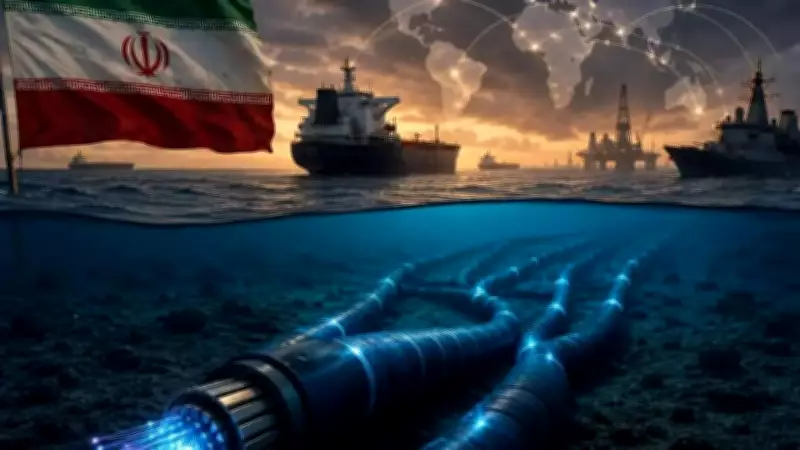
Iran has escalated tensions in the Persian Gulf by threatening to impose tariffs on undersea internet cables that cross the Strait of Hormuz. This move comes as Tehran continues to choke global oil supplies through the strategic waterway, through which 20% of the world's oil and gas passes. Now, Iran aims to leverage its geographical position to control regional internet connectivity.
Iran's Threat to Undersea Cables
Tehran has announced plans to levy fees on submarine communication cables that keep the Gulf region online. Iranian military spokesperson Ebrahim Zolfaghari stated on social media, "We will impose fees on internet cables." Iranian media elaborated that specific companies, including Google, Meta, Microsoft, and Amazon, are targeted for these tariffs.
Strategic Importance of Undersea Cables
Undersea internet cables, also known as submarine communications cables, carry more than 95% of global internet and data traffic across continents. Stretching thousands of kilometers along the ocean floor, these fiber optic cables connect countries, military networks, data hubs, and financial centers. Any disruption could affect stock markets, defense networks, and internet connectivity across entire regions. The vulnerability was highlighted during the 2008 submarine cable disruption near Egypt, which caused internet slowdowns across Asia and the Middle East. India experienced 60-70% disruption in banking, stock trading, and IT services.

Cables in the Strait of Hormuz
Approximately seven major cables run under the Strait of Hormuz. Notable among them are:
- Asia-Africa-Europe-1 (AAE-1): Connects Southeast Asia and Egypt to Europe.
- FALCON: Connects India and Sri Lanka to Gulf countries.
- GBI (Gulf Bridge International): Links all Gulf countries, including Iran.
Some of these cables terminate in Mumbai, India.
Impact of Disruption
A major disruption to these cables would severely affect Gulf countries such as Saudi Arabia, UAE, Qatar, Kuwait, Bahrain, Iran, and Oman. These nations have a combined population of over 60 million, including about 9.5 million Indians. Millions rely on internet-based communication, and a prolonged connectivity outage, combined with ongoing oil supply disruptions, would compound economic pressure on the region.
Vulnerability to Sabotage
While Iran lacks sophisticated deep-sea capabilities, the Persian Gulf's geography lowers operational challenges. The gulf is relatively shallow, with an average depth of around 50 meters, making cables vulnerable to unmanned underwater vehicles and sabotage through covert diving missions.
Geopolitical Implications
As the Gulf crisis deepens, undersea internet cables are becoming a new strategic vulnerability alongside oil routes and shipping lanes. Even a limited disruption could impact global internet connectivity, highlighting how critical digital infrastructure is increasingly becoming part of modern geopolitical conflict.