

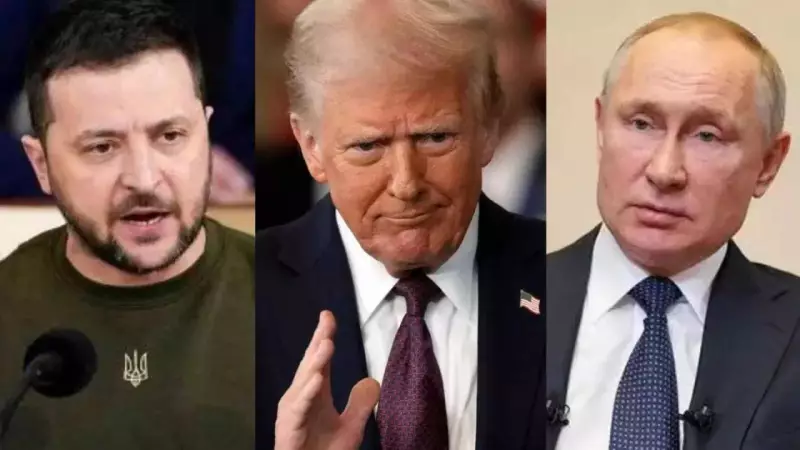
Ukraine faced a brutal and extended aerial bombardment from Russian forces this weekend, casting a dark shadow over a pivotal diplomatic mission. The assault, one of the longest and heaviest on the capital Kyiv this year, unfolded just hours before President Volodymyr Zelenskyy was scheduled to travel to Florida for high-stakes talks with US President Donald Trump.
Ten-Hour Onslaught on Kyiv
Beginning around 1:30 AM local time, Russia pounded Kyiv and its surrounding regions with successive waves of ballistic missiles and attack drones. The air-raid sirens and thunderous explosions echoed across the city for nearly ten hours, in what Ukrainian air force officials described as a barrage involving 519 drones and 40 missiles.
Fires erupted in multiple districts, thick smoke blanketed the skyline, and air-defence systems worked relentlessly through the night. The attack specifically targeted energy and civilian infrastructure, causing widespread disruption. The scale and duration marked it as one of the most sustained assaults on the capital in 2024, leaving large parts of the city without electricity or heating amid freezing winter temperatures.

Civilian Toll and Widespread Damage
The human cost of the attack was severe. At least two people were killed—one in Kyiv and another in its suburbs—while more than 30 others were wounded, including two children. Authorities reported strikes at seven different locations across the capital.
Significant damage was inflicted on residential buildings. An 18-storey block in the Dnipro district caught fire, and a 24-storey building in Darnytsia was struck. Blazes also broke out in the Obolonskyi and Holosiivskyi districts. Ukrainian Interior Minister Ihor Klymenko confirmed that more than 10 residential buildings were damaged. The reach of the strikes extended beyond the city limits, with emergency crews rescuing a person trapped under rubble in Vyshhorod, in the wider Kyiv region.
Critical Infrastructure Paralyzed
The attack crippled essential services. President Zelenskyy stated that electricity and heating were knocked out in several districts of Kyiv and the surrounding area. Ukraine's largest private energy company, DTEK, reported extensive power outages affecting hundreds of thousands of customers. A senior government minister, Oleksiy Kuleba, revealed that over 40% of residential buildings in Kyiv lost heating as temperatures plummeted. Repair crews worked under dangerous conditions, often waiting for air-raid alerts to cease before beginning restoration efforts.
Zelenskyy's Diplomatic Mission Under Fire
From Halifax, Canada, where he made a stopover en route to the US, President Zelenskyy framed the assault as Moscow's unambiguous rejection of peace efforts. "This attack is again, Russia's answer on our peace efforts. And this really showed that Putin doesn't want peace," he declared alongside Canadian Prime Minister Mark Carney. On social media, he wrote that while Russian representatives engage in talks, "Kinzhal missiles and 'shahed' drones speak for them."
During his Canada visit, Prime Minister Carney announced fresh economic assistance of CAN$2.5 billion (US$1.8 billion) to support Ukraine's reconstruction and help unlock further international financing.
The High-Stakes Mar-a-Lago Meeting
The backdrop of the attack sets the stage for Zelenskyy's critical meeting with President Trump at the Mar-a-Lago resort in Florida. This will be their first in-person encounter since October. Zelenskyy aims to secure Trump's approval for a revised 20-point peace plan intended to end the nearly four-year-long war.
The new proposal, shaped through weeks of US-Ukraine negotiations, would freeze fighting along current front lines and could involve creating demilitarised buffer zones. It represents Kyiv's clearest acknowledgment yet of possible territorial concessions, though it does not agree to a full withdrawal from the parts of Donetsk region it still controls—a core Russian demand. Zelenskyy has stressed that security guarantees, potentially mirroring NATO's Article 5, are his top priority, arguing they must be simultaneous with any ceasefire to prevent future Russian aggression.

President Trump, who has centred his self-described role as a "president of peace" on ending the Ukraine war, has been non-committal, stating simply, "So we'll see what he's got." He has previously warned that any deal "doesn't have anything until I approve it."
The Kremlin, meanwhile, released footage of President Vladimir Putin in military fatigues receiving battlefield briefings. Putin asserted that if Kyiv refuses peace, Russia will achieve its aims "by military means." The massive attack on Kyiv, just before Zelenskyy's diplomatic push, served as a stark reminder of that threat.





