

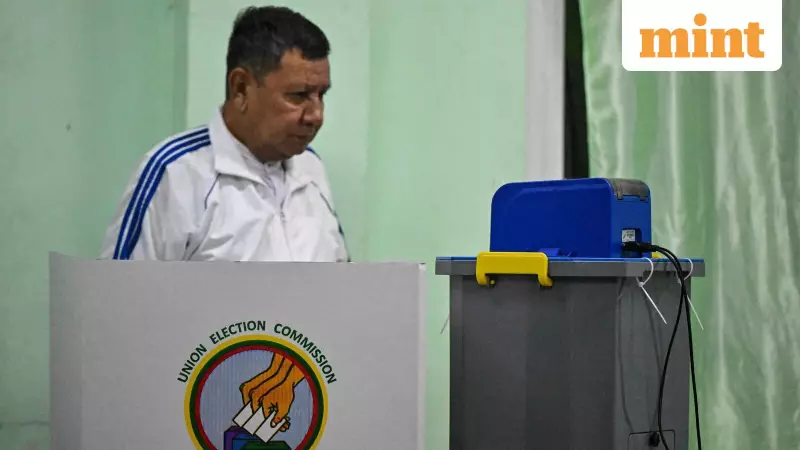
Myanmar has entered a critical new phase of military rule as the ruling junta commenced a widely condemned staged election on December 28th, 2025. This political theatre unfolds against a backdrop of a significant reversal for the country's revolutionary forces, who have suffered major setbacks after appearing to gain momentum just a year earlier.
A Daring Protest and a Shifting Battlefield
The symbolic resistance was highlighted by the daring appearance of Dr Tayzar San, Myanmar's most-wanted man, in Mandalay in early December. The doctor, who led the first protest against the 2021 coup, emerged in a market near a military headquarters to denounce the sham poll. His brief rally, met with three-finger salutes from supporters, was a bold act of defiance. However, it capped a disastrous year for the diverse coalition of rebels fighting the generals.
After threatening major cities like Mandalay in late 2024, resistance forces are now on the back foot. Ethnic minority armies have lost ground in the borderlands, and Burman-majority fighters in the country's centre have taken a severe pounding. The regime has launched brutal new offensives to seize territory ahead of the three-phase election, which concludes on January 25th.

Four Factors Behind the Rebel Reversal
Analysts point to four primary reasons for this dramatic shift in fortunes. First, and most significant, is the intervention of China. Fearing instability if the junta collapses, Beijing has moved to cut supply lines for rebel groups along its shared border. It forced two major ethnic militias to return territory captured in 2024—kidnapping one leader to ensure compliance—and ordered them to stop selling ammunition to other rebel armies. This has created a critical shortage of bullets for those still fighting.
Second, the evisceration of the US Agency for International Development (USAID) under Donald Trump has had severe indirect consequences. While USAID did not directly arm rebels, its humanitarian aid to populations in rebel-held areas freed up resources. With the agency closed, groups like the Karenni State resistance have been forced to divert 60% of their military budget (around $10 million) to meet basic needs, crippling their combat effectiveness and contributing to the loss of key settlements.
The final two factors are tactical. The junta has bolstered its ranks with 80,000 to 100,000 conscripts, many reportedly trained by Russian advisors and sent in massive, drug-fueled waves to overwhelm rebel positions. Simultaneously, the military has innovated in aerial warfare, deploying Chinese drones and using motorised paragliders—similar to those used by Hamas in the 2023 attack on Israel—to strike schools and clinics in rebel areas, undermining their ability to govern.
Legitimacy, Internal Politics, and a Grim Future
The staged election is a cornerstone of the junta's strategy. Despite ongoing conflict making voting impossible in large areas, the generals decree that any constituency able to open even a single polling station will elect an MP. Over 200 people have already been charged with interfering, including some who merely cheered Dr Tayzar San. While 55 parties are registered, all credible opposition is banned.
This poll aims to provide a veneer of legitimacy for the isolated regime, potentially allowing some Southeast Asian nations, who regret shunning Myanmar, a pretext to re-engage. It may also ease internal tensions. Top brass blame the dim and inept leader, Min Aung Hlaing, for 2024's losses. Foreign diplomats speculate he may relinquish either the presidency or commander-in-chief title post-election, a move pushed by Chinese diplomats who find him difficult. This could foster a more consensual leadership style without a real transfer of power.
For ordinary Myanmar citizens, however, little improvement is expected. Dr Tayzar San and his fellow revolutionaries reject the notion that a sham vote will change anything. After five years of struggle, they continue to hold out for a genuine democratic process, even as the military tightens its grip through a combination of brute force and political manipulation.






