

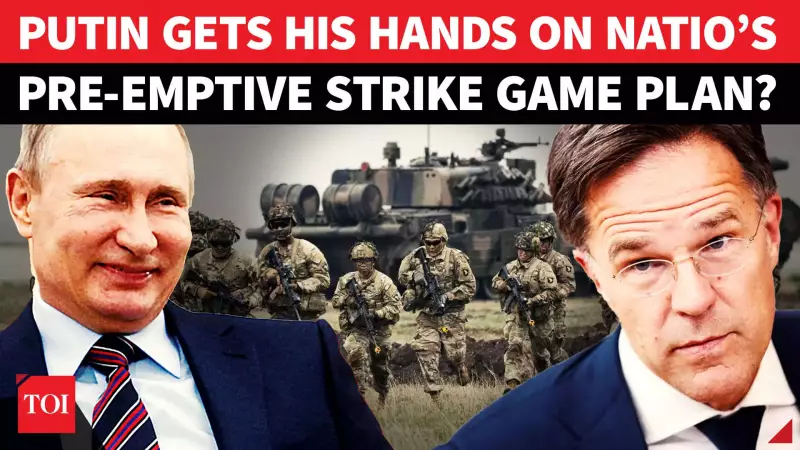
A senior NATO military commander has sent shockwaves through global diplomatic circles by openly suggesting the alliance could contemplate a pre-emptive military strike against Russia. This unprecedented statement, framed as a potential defensive measure, marks a radical departure from the bloc's longstanding strategic doctrine.
A Stark Departure from Traditional NATO Posture
The controversial remark came from Admiral Giuseppe Cavo Dragone, the Chairman of the NATO Military Committee. His comments, made public on December 1, 2025, have ignited intense debate among security analysts and state officials worldwide. For decades, NATO's public stance has been fundamentally defensive, anchored in the principle of collective defence enshrined in Article 5 of its founding treaty. Dragone's suggestion reinterprets the concept of defence in a far more proactive, and to some, provocative manner.
This strategic bombshell was dropped against a backdrop of already sky-high tensions. Russia has repeatedly voiced alarm over what it calls unprecedented levels of NATO military activity along its western flank, including large-scale exercises and enhanced troop deployments. The Admiral's statement is likely to further inflame these existing frictions, potentially altering the security calculus for the entire Euro-Atlantic region.

Context and Immediate Reactions
Analysts were quick to note the gravity of the admission. Such direct language from NATO's top uniformed officer is rare and signals a possible hardening of the alliance's internal discussions regarding the threat posed by Moscow. The concept of a pre-emptive strike, while discussed in theoretical military circles, is almost never articulated publicly by officials of such high rank within a defensive alliance.
The immediate global reaction has been one of deep concern. Diplomats are parsing the statement to understand whether it represents a trial balloon for a new NATO policy or the personal viewpoint of the military commander. Either way, it has shifted the narrative, forcing a conversation about the limits of defence in an era of hybrid warfare and constant nuclear posturing.
Broader Implications for Global Security
This development does not occur in a vacuum. It coincides with other major international flashpoints, underscoring a period of significant global instability. The news report referencing Dragone's comment also highlighted several other critical situations:
- Escalating conflict dynamics in the Black Sea region, with reports of drone attacks on vessels.
- Rising tensions between the United States and Venezuela, including airspace restrictions.
- Political friction within Europe, exemplified by Hungary's Prime Minister Viktor Orban declaring a 'conflict with Europe' over Russia policy.
- Internal strife in Germany with protests against far-right groups.
Together, these events paint a picture of a world where traditional alliances are being tested and the rules of engagement are being publicly re-evaluated. Admiral Dragone's statement on a potential pre-emptive strike against a nuclear-armed state like Russia raises profound questions about risk, escalation, and the future of deterrence. It places a stark spotlight on the fragile state of great-power relations as we move deeper into the decade.






