

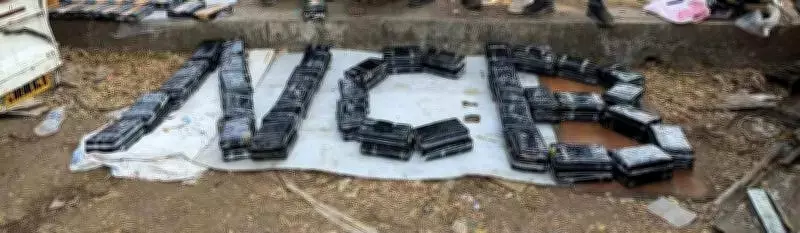
The Narcotics Control Bureau (NCB) has successfully dismantled a transnational drug supply syndicate with the seizure of 349 kilograms of high-grade cocaine, valued at Rs 1,745 crore in the illicit market. This operation followed coordinated raids in warehouses located in the Kalamboli–Bhiwandi corridor.
Details of the Seizure
The drugs were smuggled into India by concealing packets within the cavities of imported machinery. In one warehouse, the contraband was found stuffed into cricket pads and gloves, raising suspicions about its distribution method within the country. The NCB's 'Operation White Strike' was the result of over six months of sustained intelligence gathering, surveillance, and inter-agency coordination. Officials did not disclose the country of origin but noted that the scale of the seizure is significant, as India typically records annual cocaine seizures of 200–300 kilograms.
Government Response
Union Home Minister Amit Shah tweeted, "We are resolved to ruthlessly crush the narcotics cartel. This is a trailblazing example of a bottom-to-top approach where the agency traced back a smaller consignment to net a massive network." Acting on specific and credible inputs, multiple NCB teams launched coordinated strikes in the Kalamboli–Bhiwandi corridor across Navi Mumbai and Thane districts, exposing a highly organised transnational drug supply network that utilized warehouse infrastructure and concealed transport mechanisms, according to a press release issued by PIB.

Sequence of Raids
The first seizure occurred near the KWC Warehousing Complex in Kalamboli, where officials intercepted a car and recovered 136 kilograms of cocaine concealed inside cricket pads and gloves packed in cartons. The driver was arrested. Based on his interrogation, officials traced a larger consignment to a warehouse in Laxman Compound in Rehnal village, Bhiwandi. A subsequent raid led to the recovery of an additional 213 kilograms of cocaine, bringing the total seizure to 349 kilograms.
Concealment Method
Officials reported that the contraband was concealed within the inner cavities of imported machinery, with each packet wrapped in nine layers of polyethylene, including a black greasy coating to evade detection. Investigators suspect that the syndicate used the Kalamboli–Bhiwandi warehousing network for storage and distribution. A team from NCB Delhi and Mumbai is continuing raids and searches at several locations, while further investigation is underway to identify the masterminds, financiers, and distribution network linked to the syndicate.






