The modern National Football League draft has evolved into one of the biggest annual events in American sports, spanning multiple days with extensive television coverage, scouting networks, live analysis, and millions of viewers tracking every pick in real time. However, the system that now shapes the league's competitive structure began in a far less glamorous setting during a 13-hour meeting between owners and coaches at a hotel in Pittsburgh on May 19, 1935. At that time, a struggling team owner proposed a system designed simply to prevent wealthy clubs from monopolizing the best players. Before that moment, college players entering professional football were free to sign with any team they chose, a structure that consistently favored richer and more successful franchises while leaving weaker clubs trapped in cycles of mediocrity from which they could rarely escape. The proposal adopted that day would permanently change the economics and competitive balance of the league and eventually grow into what the NFL still formally calls the 'Annual Player Selection Meeting.'
Bert Bell's Proposal Emerged from Financial Survival, Not Spectacle
The driving force behind the draft proposal was Bert Bell, who at the time co-owned the Philadelphia Eagles and was struggling desperately to keep the franchise competitive and financially stable during its early years. The Eagles had little success in their first two seasons and found themselves unable to compete for top college talent against teams with greater financial resources. Ticket sales suffered, stronger clubs kept getting stronger, and the gap across the league continued widening. After the NFL introduced a waiver system in 1934 allowing teams to pick up available players, Bell concluded that the league needed a more structured mechanism to distribute talent if weaker franchises were going to survive long term. At a league meeting on May 19, 1935, owners unanimously approved Bell's proposal for an annual system in which teams would select college players in reverse order of the previous season's standings, giving struggling teams the first opportunity to sign elite prospects.
The Historic Meeting at the Fort Pitt Hotel
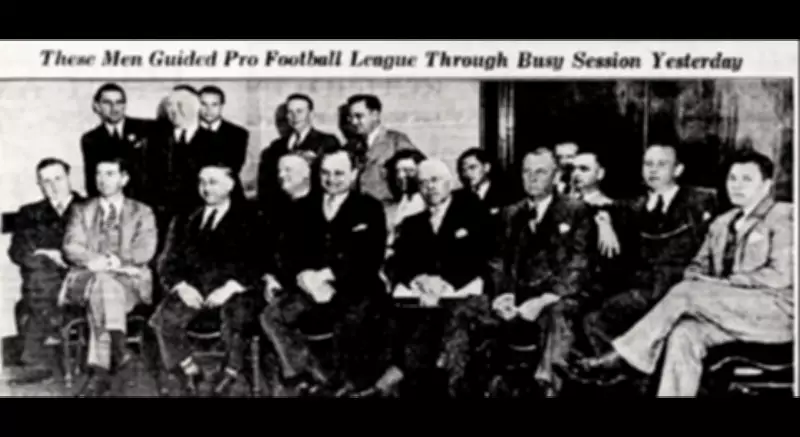
The meeting itself took place at the Fort Pitt Hotel in Pittsburgh and was hosted by Art Rooney Sr., the founding owner of the franchise then known as the Pittsburgh Pirates before it later became the Steelers. Rooney, widely known as 'The Chief,' had purchased the team in 1933 and would go on to become one of the most respected figures in professional sports. Contemporary reports from The Pittsburgh Press described the lengthy meeting at Rooney's offices, where the key principles of the future draft system were formally outlined.

The Word 'Draft' Was Not Originally Part of the Proposal
One of the stranger details surrounding the origins of the NFL draft is that Bell never actually used the word 'draft' during his original presentation to fellow owners. The official name adopted for the process was the 'Annual Player Selection Meeting,' terminology the league technically still uses today despite 'NFL Draft' becoming the universally recognized public label over time. Even in modern broadcasts, presenters still formally introduce the event using its original title before shifting into the draft branding more familiar to audiences.
The First NFL Draft in 1936
The first draft itself took place on February 8, 1936, at the Ritz-Carlton Hotel in Philadelphia, with nine franchises represented and 81 players selected across nine rounds. Those nine teams were: Philadelphia Eagles, Boston Redskins, Pittsburgh Pirates, Brooklyn Dodgers, Chicago Cardinals, Chicago Bears, Green Bay Packers, Detroit Lions, and New York Giants. There were no formal scouting departments, no agents, no television coverage, and no around-the-clock media infrastructure surrounding the event. Teams built their player lists using newspaper reports, recommendations, local college visits, and conversations with coaches and executives.

With the first overall selection, the Eagles drafted Jay Berwanger, the University of Chicago halfback who had won the Heisman Trophy. Despite becoming the first player ever selected in an NFL draft, Berwanger never actually played professional football and instead chose to work as a foam rubber salesman. That decision reflected the reality of the league at the time, because professional football did not yet offer the financial security or prestige it would later develop. Only 24 of the 81 players selected in the inaugural draft ultimately went on to play in the NFL, with many choosing professions that paid more reliably.
The Structure Evolved Rapidly During the Following Decades
The format introduced in 1936 did not remain static for long, with the league repeatedly adjusting the number of rounds and selection procedures over the following decades as professional football expanded. The inaugural draft featured nine rounds before increasing to 10 rounds in 1937. It expanded again to 20 rounds in 1939, while another variation introduced during the 1938 and 1939 drafts allowed only the five lowest-finishing teams from the previous season to make selections during the second and fourth rounds. The number of rounds continued fluctuating heavily: 12 rounds in 1937, 22 rounds in 1938, 32 rounds annually between 1943 and 1948, 30 rounds throughout the 1950s, and 20 rounds between 1960 and 1966.
When the NFL and the American Football League agreed to merge, the leagues introduced a 17-round common draft beginning after the 1966 season. Over time, the number of rounds steadily reduced again, first dropping to 12, then eight, before eventually settling into the current seven-round system used today. What began in 1935 as a survival mechanism proposed by an owner struggling to keep his franchise alive ultimately became one of the defining structures in American professional sport, shaping competitive balance, player movement, and league economics for nearly a century.