

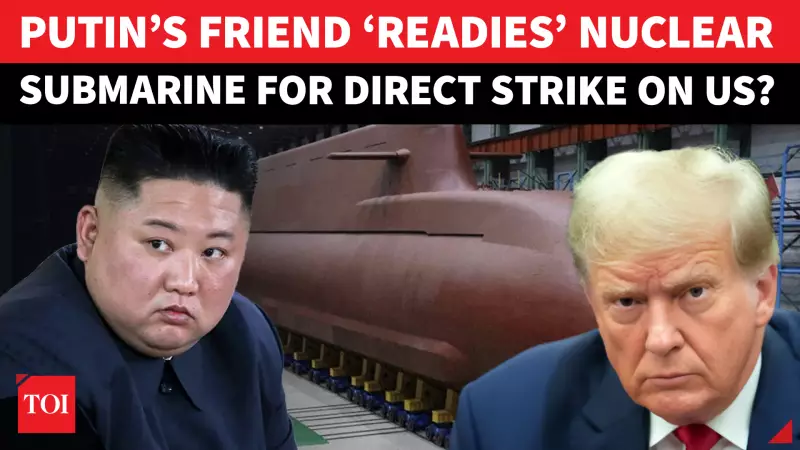
In a significant military development that has long been anticipated and feared by international security analysts, North Korea has officially revealed its first-ever nuclear-powered submarine. The announcement, made on December 25, 2025, represents a major leap in Pyongyang's naval capabilities and has sent shockwaves through global defence circles, particularly in the Indo-Pacific region.
A New Era in Naval Deterrence
The newly unveiled vessel is a substantial piece of military hardware, with a displacement of 8,700 tons. This makes it notably larger than the country's previous generations of submarines. More critically, the submarine is designed to carry and launch ballistic missiles. Analysts suggest these could potentially include advanced hypersonic glide vehicles, which are extremely difficult for existing missile defence systems to intercept.
This technological advancement is not merely an incremental upgrade. Security experts globally are interpreting this move as Pyongyang achieving a long-sought goal: a survivable second-strike nuclear capability. Unlike land-based missile silos or airfields, which are stationary and can be targeted, a nuclear-powered submarine can remain hidden underwater for extended periods. It can manoeuvre silently across vast oceans, enabling it to launch attacks from unexpected and unpredictable directions.

Direct Implications for Regional and Global Security
The strategic implications of this development are profound. For decades, the United States and its allies have monitored North Korea's ballistic missile program with deep concern. The advent of a nuclear-powered submarine fundamentally alters the strategic calculus. It provides North Korea with a platform that could, in theory, bring the threat of nuclear retaliation much closer to the U.S. mainland and its allies in the Indo-Pacific, including Japan and South Korea.
This escalation occurs against a backdrop of persistent and high tensions on the Korean Peninsula. Multiple U.S. administrations have, in the past, reportedly considered pre-emptive military strikes against North Korea's nuclear facilities. The new submarine makes any such considerations infinitely more complex and risky, as it provides Pyongyang with a hidden, mobile deterrent that would be nearly impossible to eliminate completely in a first strike.
Expert Warnings and the Path Ahead
Military analysts and non-proliferation experts are unanimous in their assessment that this marks a dangerous and destabilizing escalation in North Korea's deterrence strategy. The introduction of such a platform increases the overall risk of miscalculation and accident in an already volatile region. It complicates arms control dialogues and places additional pressure on regional security architectures.
The global community, particularly nations in the Indo-Pacific, now faces a heightened security environment. The permanent deployment of a nuclear-armed, nuclear-powered North Korean submarine would necessitate new levels of maritime surveillance, anti-submarine warfare readiness, and diplomatic coordination among allied nations to manage this persistent and evolving threat.
As of late December 2025, the international response is being closely watched. The unveiling of this submarine ensures that North Korea's military ambitions will remain at the very top of the global security agenda for the foreseeable future, demanding a recalibrated and robust strategy from the United States and its partners to ensure stability in the Indo-Pacific.






