

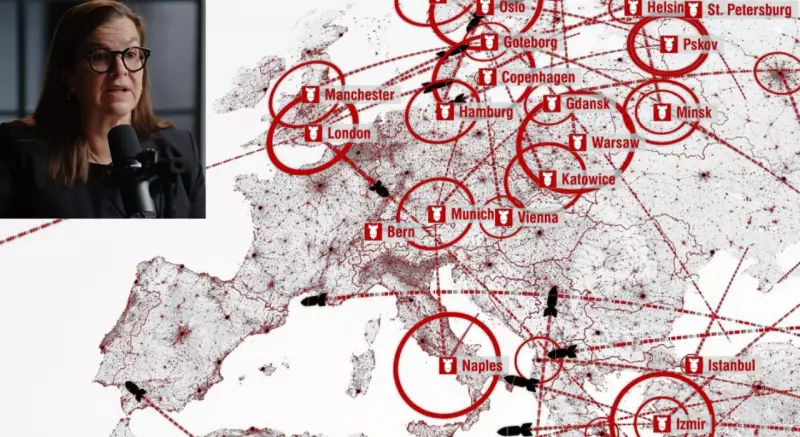
In an era marked by missile tests, regional conflicts, and geopolitical tensions, a haunting question resurfaces: if World War III erupts, where on Earth would one be safe? This is not mere speculation for investigative journalist Annie Jacobsen, who has constructed a terrifyingly plausible minute-by-minute account of a global nuclear exchange. Her conclusion, drawn from declassified documents and expert modelling, is stark: within just over an hour, billions could perish, and in the ensuing nuclear winter, only a handful of places—most notably Australia and New Zealand—might realistically sustain human life on a meaningful scale.
The 72-Minute Countdown to Global Catastrophe
Annie Jacobsen, a Pulitzer Prize-finalist author known for deep dives into US national security, outlines a specific scenario in her latest work, Nuclear War: A Scenario. The trigger is a surprise nuclear attack by North Korea on the United States. From the moment early-warning systems detect the launches, a brutal clock starts ticking.
The US president has roughly six minutes to make a decision from a counterattack list after a nuclear launch is detected. In Jacobsen's narrative, the president authorises a massive retaliatory strike. This action, however, is misinterpreted by Russia, which sees inbound US missiles and, unable to get confirmation, launches its own arsenal in response. Within 72 minutes, a thousand Russian nuclear weapons land on the United States, creating overlapping firestorms and killing hundreds of millions immediately.

Beyond the Blast: The Five Billion Death Toll from Nuclear Winter
The immediate destruction is only the beginning. Jacobsen's work heavily relies on climate modelling, particularly studies by Professor Brian Toon. The real long-term threat is nuclear winter. City-scale firestorms would inject vast amounts of soot into the upper atmosphere, blocking sunlight for years.
Global temperatures would plummet, growing seasons would vanish, and rainfall patterns would be disrupted. Major agricultural belts like the American Midwest and Ukraine could be covered in snow for a decade. Jacobsen, citing Toon's models, states that around five billion people would ultimately die from famine and the collapse of global food systems, not from the initial blasts or radiation. Fisheries and trade would collapse, and even nations untouched by warheads would face starvation.
Why Australia and New Zealand Are Singled Out for Survival
Against this apocalyptic backdrop, Jacobsen highlights a sobering assessment from her conversations with Professor Toon. Only two countries have a realistic chance of sustaining agriculture and large populations after a full-scale nuclear exchange: Australia and New Zealand. This claim is based on three critical factors.
First is their geographical location in the Southern Hemisphere, distant from the most probable northern hemisphere targets and major missile flight paths. Second, both are major agricultural exporters with relatively low population density, giving them a surplus food production capacity crucial for survival when imports vanish. Third, they possess established infrastructure and some energy independence.
Jacobsen is quick to clarify that "safest" does not mean unscathed. Life would be brutally hard, with societies pushed to their limits. However, in a world shrouded in ice and darkness, these nations might retain the fragile ability to grow food where others cannot.
Jacobsen's work is not a forecast but a detailed translation of decades of military and scientific planning into stark, human terms. It aims to replace the abstract concept of "unacceptable damage" with a visceral understanding of the consequences, underscoring that in a modern nuclear war, there are no true neutrals—only varying degrees of devastation.






