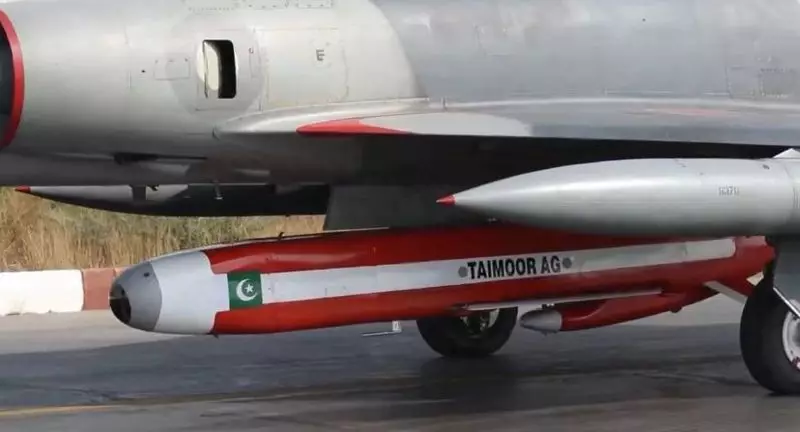
The Pakistan Air Force (PAF) has announced a significant milestone in its weapons development program. The force has successfully conducted a flight test of an indigenously developed, air-launched cruise missile named 'Taimoor'. This test marks a major step forward for Pakistan's domestic defense manufacturing capabilities.
Details of the Taimoor Missile Test
The flight test was carried out recently, though the PAF did not disclose the exact date or location of the launch. According to the official statement, the missile was launched from a fighter aircraft and successfully hit its intended target with pinpoint accuracy. The test was designed to validate the missile's advanced navigation and guidance systems, as well as its overall performance parameters.
The Taimoor is described as an air-to-ground cruise missile (AGCM). This class of weapon is designed to be launched from an aircraft, flying at low altitudes to evade enemy radar, and striking high-value stationary or moving targets on land or at sea. The successful test confirms the operational readiness of this new weapon system for integration into the PAF's fleet.

Indigenous Development and Strategic Significance
A key highlight of the announcement is the missile's indigenous development. The PAF stated that the Taimoor missile has been developed within Pakistan, showcasing the country's growing expertise in complex aerospace and weapons technology. This move aligns with a broader strategic goal of reducing dependency on foreign suppliers for critical defense equipment.
Analysts note that the name 'Taimoor' appears to be a new designation within Pakistan's missile arsenal. It is reportedly a further development or a variant of the existing Ra'ad air-launched cruise missile. The Ra'ad (meaning 'Thunder' in Urdu) has been a cornerstone of Pakistan's strategic air power, and the Taimoor likely represents an enhanced version with improved range, accuracy, or payload capabilities.
Implications for Regional Dynamics
The successful test of the Taimoor missile is a clear signal of Pakistan's commitment to modernizing its air force and strengthening its deterrent posture. The development of advanced, locally-produced cruise missiles provides the PAF with greater operational flexibility and strategic autonomy.
This advancement in air-to-ground strike capabilities adds a new layer to Pakistan's military prowess. Cruise missiles like the Taimoor are difficult to detect and intercept due to their low-altitude flight paths, making them potent tools for precision strikes against critical infrastructure and military installations in potential conflict scenarios.
The test also underscores the ongoing technological competition in South Asia. Neighboring countries, including India, have been actively developing and testing their own suite of cruise and ballistic missiles. Pakistan's progress with the Taimoor missile is a direct response to this regional arms dynamic, aiming to maintain a balance of power.
In conclusion, the flight test of the Taimoor missile is more than just a routine weapons check. It represents a significant achievement for Pakistan's defense research and development sector and a notable enhancement of the Pakistan Air Force's combat potential. As the system moves towards full operational deployment, it will undoubtedly be a critical asset in the nation's aerial defense strategy for years to come.