

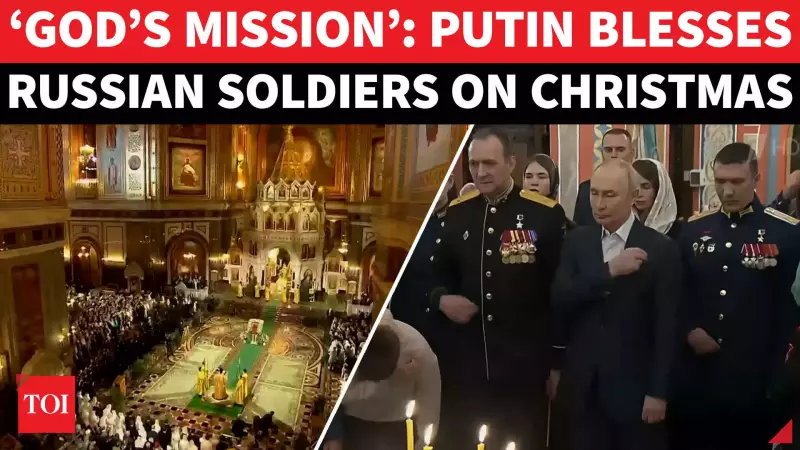
In a significant move blending faith with nationalistic fervour, Russian President Vladimir Putin attended a Christmas church service near Moscow on January 7, 2026, delivering a powerful message to his nation's military. The event, which included soldiers, veterans, and their families, saw the Russian leader frame the ongoing conflict in Ukraine as a divinely sanctioned mission.
Putin's Christmas Message: A Sacred Duty
Standing amidst uniformed personnel, President Putin directly addressed Russian troops, praising them as 'warriors of the Lord' engaged in a holy mission. His speech strategically positioned the war, now nearing its fourth gruelling year, not just as a geopolitical struggle but as a spiritual obligation to defend the fatherland. This appearance was carefully orchestrated, leveraging the solemnity of Orthodox Christmas to bolster troop morale and domestic support.
The Kremlin's reliance on religious and patriotic symbolism has become a cornerstone of its narrative as the war drags on. By invoking God and sacred duty, the leadership aims to reinforce concepts of unity, sacrifice, and unwavering faith among the populace. This approach is seen as a critical tool to maintain resilience in the face of mounting casualties and sustained international pressure and sanctions.

The Kremlin's Strategic Narrative
Analysts observe that this event is part of a prolonged pattern where the Russian state merges Orthodox Christian iconography with militant patriotism. The timing, on one of the most important religious holidays for the Russian Orthodox Church, was no coincidence. It served to sanctify the military campaign, offering a transcendental justification for the sacrifices being made.
This public relations strategy is designed for both internal and external audiences. Domestically, it seeks to solidify the support base by presenting the war as a righteous, defensive crusade. Internationally, it projects an image of a nation united not just behind its political leader, but behind a cause it believes is blessed by a higher power.
Context and Implications
The event underscores the deepening intertwining of the Russian Orthodox Church and the state under Putin's long tenure. As the conflict's human and economic costs continue to rise, the Kremlin is doubling down on narratives that appeal to tradition, spirituality, and national destiny to sustain public endurance.
This faith-based framing also presents a stark challenge to Western narratives about the war, creating a fundamental clash of perspectives that is difficult to bridge through diplomacy. For the soldiers on the front lines and their families, such rhetoric is intended to provide a profound sense of purpose that transcends the immediate horrors of warfare.
As global observers watch, the use of Orthodox Christmas for such a proclamation highlights the central role ideological and spiritual warfare plays in this prolonged conflict, potentially shaping its trajectory for the foreseeable future.






