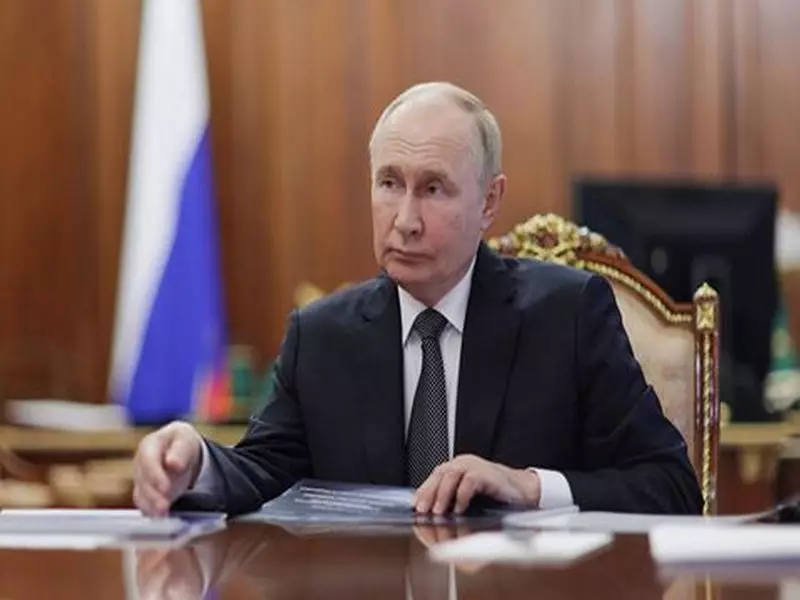
Russian President Vladimir Putin has issued a stark warning, stating that if Kyiv is not interested in peace, Russia will achieve all the goals of its special military operation through military means. The statement was made during a press conference following his talks with Belarusian President Alexander Lukashenko in Moscow on Thursday.
Putin's Ultimatum on Peace Negotiations
President Putin directly linked the continuation of the conflict to Ukraine's willingness to engage in serious peace talks. He asserted that the ball is now in Ukraine's court, emphasising that Russia has never refused to negotiate. The Russian leader claimed that Moscow is ready for talks, but placed the responsibility for their failure squarely on the Ukrainian side and its Western backers.
"We are for peace," Putin stated, but immediately followed with a condition. He argued that if Kyiv does not desire a peaceful resolution, then Russia will be compelled to pursue its objectives on the battlefield. This framing presents Russia's potential escalation as a forced response to Ukrainian intransigence, a narrative central to Moscow's diplomatic messaging.

The Context of the Statement
This declaration comes at a critical juncture in the prolonged conflict. Putin made these remarks after discussions with his close ally, Belarusian President Alexander Lukashenko. The meeting itself underscores the continued coordination between Moscow and Minsk, with Belarus having served as a launchpad for Russian forces during the initial invasion in February 2022.
The Russian President's comments can be seen as both a political maneuver and a strategic signal. By publicly stating readiness for dialogue, he aims to position Russia as a reasonable actor on the international stage, particularly for audiences in the Global South. Simultaneously, the explicit threat of military action serves to pressure Ukraine and its allies by suggesting that rejection of talks will lead to further devastating conflict.
Implications for the War and Global Diplomacy
Putin's ultimatum has significant implications. Firstly, it attempts to shift the global perception of blame for the ongoing war onto Ukraine and NATO countries. Secondly, it sets a public precondition for any future negotiations, potentially complicating behind-the-scenes diplomatic efforts.
The statement effectively rules out any unilateral Russian ceasefire or withdrawal, making clear that Moscow intends to continue its campaign until its stated goals are met. These goals, which Putin has previously defined as the "demilitarisation" and "denazification" of Ukraine, along with securing the status of Crimea and the Donbas region, are viewed as non-starters by the Ukrainian government.
For Ukraine and its Western supporters, Putin's words are likely to be interpreted not as a genuine offer for peace but as a demand for surrender. The Ukrainian leadership has consistently stated that negotiations can only begin once Russian forces fully withdraw from internationally recognised Ukrainian territory, including Crimea. This creates a fundamental deadlock, with both sides demanding concessions the other is unwilling to make.
Ultimately, Putin's warning reinforces the grim reality that a decisive military outcome, rather than a swift diplomatic one, appears to be the more probable path forward as the war grinds on. The threat underscores the high stakes for regional stability and global security, with the potential for further escalation remaining acute.