

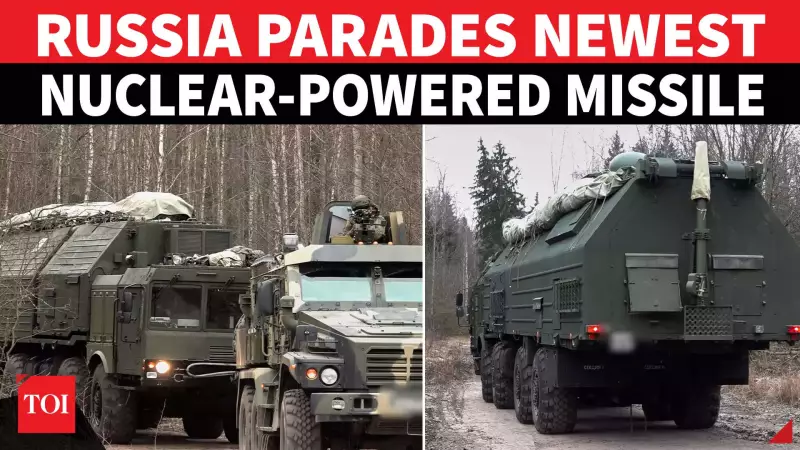
In a significant escalation of military posturing, Russia has officially deployed its advanced Oreshnik hypersonic missile system to the territory of its ally, Belarus. This move places the formidable new weapon system directly on the borders of the NATO alliance and Ukraine.
Video Reveals Deployment of Advanced Weapon System
Moscow released video evidence confirming that the Oreshnik missile system has entered active combat duty. The deployment to Belarus, a nation sharing borders with NATO members Poland, Lithuania, and Latvia, as well as Ukraine, is seen as a strategic power play. Russian military officials have made bold claims about the system's capabilities, stating it travels at speeds exceeding ten times the speed of sound (Mach 10+). They assert that at such velocities, the missile is currently impossible to intercept with existing defence systems.
Capabilities That Redefine Warfare Timelines
The Oreshnik is not just fast; it represents a multi-faceted threat. A key feature of the system is its ability to carry multiple independently targetable re-entry vehicles (MIRVs). This means a single missile can deliver several nuclear or conventional warheads, each programmed to hit a different target. The combination of hypersonic speed and MIRV technology dramatically shortens warning times for any potential adversary, compressing the decision-making window in a crisis to mere minutes.

Deployment Amid Rising Tensions and Future Plans
This provocative deployment occurs against a backdrop of persistently high tensions over the war in Ukraine. The timing sends a clear strategic message to the West. Furthermore, Russian President Vladimir Putin has signalled that the Oreshnik system will soon enter service within Russia's own borders, indicating a planned broader rollout of this new generation of weaponry. The move to station it first in Belarus amplifies its immediate threat projection, bringing a weapon designed to evade modern defences to the doorstep of the European Union and NATO.
Analysts view this as a calculated move by the Kremlin to demonstrate its advanced military technology and to counter Western support for Ukraine. The stationing of such a system in Belarus, which was used as a staging ground for the 2022 invasion of Ukraine, further deepens the military integration between Moscow and Minsk and presents a new, complex challenge for regional security architectures.






