

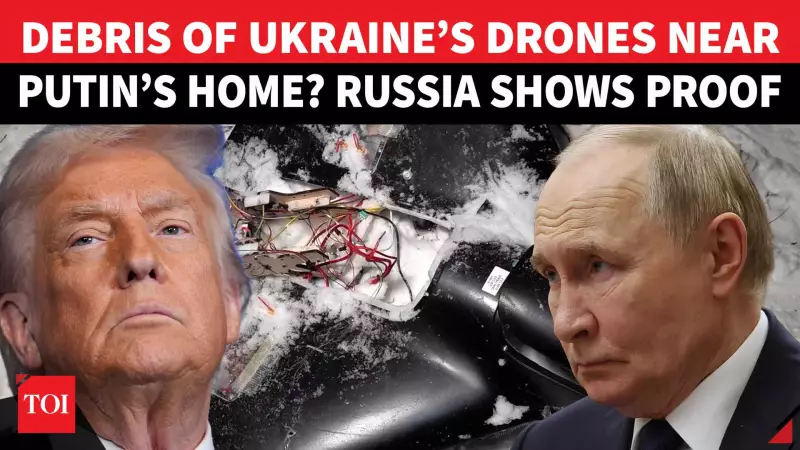
In a dramatic escalation of diplomatic tensions, Russia has presented what it calls physical proof of an attempted Ukrainian drone strike on President Vladimir Putin's private residence. The incident, which Moscow claims occurred on December 29, has become a focal point in the ongoing information war between the two nations.
The Handover of Evidence
The Russian Defence Ministry released a video that forms the core of its allegations. The footage shows Admiral Igor Kostyukov, the chief of Russia's military intelligence agency, handing over a piece of hardware to a representative of the United States. The item in question is described as a decrypted navigation controller from a drone.
Moscow states that this component was recovered from an unmanned aerial vehicle that was intercepted. Russian authorities insist the device's flight data clearly indicates its final programmed destination was a specific facility within President Putin's presidential compound in Novgorod. The act of formally presenting this evidence to the U.S. military attaché is seen as a direct challenge to Washington.

CIA's Prior Rejection and the Timing
This move by the Russian MoD did not occur in a vacuum. It comes directly after reports emerged that the Central Intelligence Agency (CIA) of the United States had rejected Russia's initial allegations regarding the attack. The CIA had reportedly given a 'clean chit' to Ukrainian President Volodymyr Zelensky's government, dismissing Moscow's claims as baseless.
By physically presenting the evidence to a U.S. official, Russia is attempting to force a recalculation of the American position. It frames the handover as an act of transparency, while simultaneously putting the Biden administration in a diplomatically awkward position. The message is clear: Russia believes it has incontrovertible proof that implicates Kyiv in a direct attack on the Russian head of state.
Broader Implications and the War of Narratives
This event is more than a simple exchange of evidence; it is a strategic play in the broader geopolitical conflict. Accusing Ukraine of attempting to assassinate President Putin represents one of the most serious allegations possible. If proven and accepted internationally, it could be used to justify further escalation in Russia's military campaign.
However, the CIA's earlier dismissal highlights the deep distrust and the competing narratives that define this war. Ukraine has consistently denied targeting civilian leaders or locations deep inside Russia, though it has claimed responsibility for strikes on military and logistical targets. The world is now presented with two opposing realities: one backed by physical evidence presented by Russian intelligence, and another supported by the assessment of American intelligence.
The development underscores the critical role of information warfare. Control of the narrative can influence international support, weapon supplies, and diplomatic pressure. As of now, neither side shows signs of backing down, setting the stage for further confrontations both on the battlefield and in the realm of global diplomacy.






