

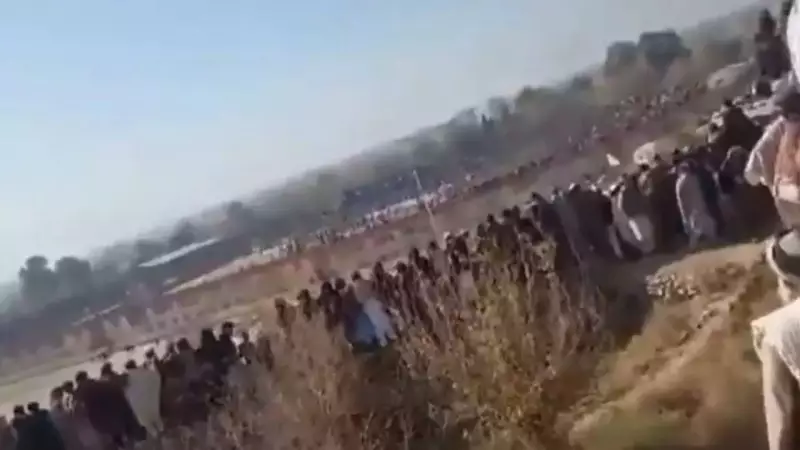
A chilling public execution orchestrated by the Taliban in Afghanistan has drawn global condemnation, not only for the act itself but for the identity of the executioner: a 13-year-old boy. The event, which unfolded in a packed stadium, underscores the hardline regime's strict interpretation of Islamic law and its use of public spectacles to enforce control.
A Stadium of Spectators Witnesses a Grisly Act
The execution took place on Tuesday in the central stadium of Khost, an eastern province of Afghanistan. In a deeply harrowing scene, nearly 80,000 people were gathered to witness the event, following public notices issued by Taliban officials the previous day encouraging attendance. The man put to death was identified by local sources as Abdul Rahman, son of Zabit, though the Taliban's supreme court named him as Mangal, son of Talah Khan.
Reports from local media outlet Amu TV, citing residents, state that the convicted man was accused of murdering members of the teenage boy's family with a Kalashnikov rifle. The Taliban court stated the killing was a "retaliatory punishment" for murder, following a case that had been "thoroughly and repeatedly reviewed" through primary, appeals, and high courts, with final authorization from the Taliban's supreme leader.

The 13-Year-Old Handed the Weapon
The most disturbing detail of the execution was the direct involvement of a child. Before the killing, Taliban officials reportedly approached a young relative of the victim—the 13-year-old boy—and asked if he wished to pardon the condemned man. When the boy refused, they placed a weapon in his hands and instructed him to carry out the execution. Moments later, inside the crowded Khost stadium, the teenager fired the fatal shots.
The Taliban court, in its statement, noted that "the families of the victims were offered amnesty and peace, but they refused." The executed man was originally from Sanjak village in Paktia’s Syed Karam district but had been living in Khost's Ali Shir and Terezio districts.
International Scrutiny and Taliban Justice
This public execution marks a stark return of Taliban practices common during their previous rule in the late 1990s, where such punishments were carried out in sports stadiums. The event has sparked renewed international concern about human rights under the Taliban administration, particularly regarding the use of capital punishment and the involvement of minors in judicial processes.
The spectacle, designed to serve as a deterrent, highlights the regime's commitment to its harsh interpretation of Sharia law, known as "qisas" or retributive justice. It stands in sharp contrast to global norms on juvenile protection and fair trial standards, drawing inevitable criticism from human rights organizations worldwide.






