

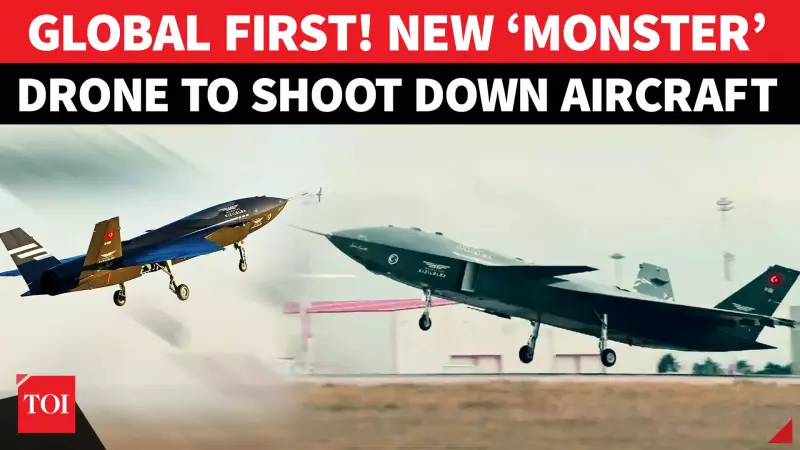
In a development that has sent shockwaves through global defence circles, Turkey has successfully tested an unmanned fighter jet capable of destroying aerial targets beyond visual range. This milestone event, confirmed on December 1, 2025, marks a significant leap in military technology and has profound implications for the future of aerial warfare.
A Historic First in Aerial Combat
The test, reported by TRT World, featured the indigenously developed Kızılelma unmanned combat aerial vehicle (UCAV) from Turkish defence giant Baykar. The drone successfully executed a beyond-visual-range (BVR) air-to-air kill during its trials. It utilised its advanced Murad AESA radar to lock onto and engage a high-speed target, which was then neutralised by a Gökdoğan missile.
This achievement is monumental as it represents the first verified air-to-air combat capability demonstrated by an uncrewed platform. Until now, drones have primarily been used for surveillance or strikes against ground targets. The ability to autonomously detect, track, and destroy another aircraft in the sky places Turkey at the forefront of a new era in drone warfare.

Showcasing Manned-Unmanned Teamwork
Further underscoring the strategic intent behind this technology, footage released shows the Kızılelma flying in a mixed formation alongside Turkey's F-16 fighter jets. This visual is a powerful statement of Ankara's ambition to pioneer manned-unmanned combat integration.
This concept involves piloted aircraft working seamlessly alongside intelligent drone wingmen, effectively multiplying the force's capabilities and survivability. The successful test and formation flying indicate that Turkey is rapidly moving from theory to practical application in this critical area, a domain being closely watched by major military powers worldwide.
Global Repercussions and a Shifting Balance
The successful test has stunned global militaries and shaken long-held Western defence assumptions. It showcases Turkey's accelerating technological leap in the defence sector, achieved despite various international constraints and embargoes. The Kızılelma's capabilities suggest a potential shift in the balance of aerial power, especially in regions like the Middle East and Eastern Europe.
Analysts suggest this advancement could alter strategic calculations for several nations, including those in the West. It proves that advanced, game-changing military technology is no longer the exclusive domain of traditional superpowers. Turkey's demonstration of a working unmanned fighter jet capable of air-to-air combat sets a new benchmark and will undoubtedly accelerate similar programs in other countries.
In conclusion, the December 1, 2025 test of the Baykar Kızılelma is more than a national achievement for Turkey; it is a historic moment in military aviation. By proving that an unmanned platform can perform the complex task of air-to-air engagement, Turkey has not only rattled existing defence paradigms but has also firmly positioned itself as a leading innovator in the future of warfare.






