

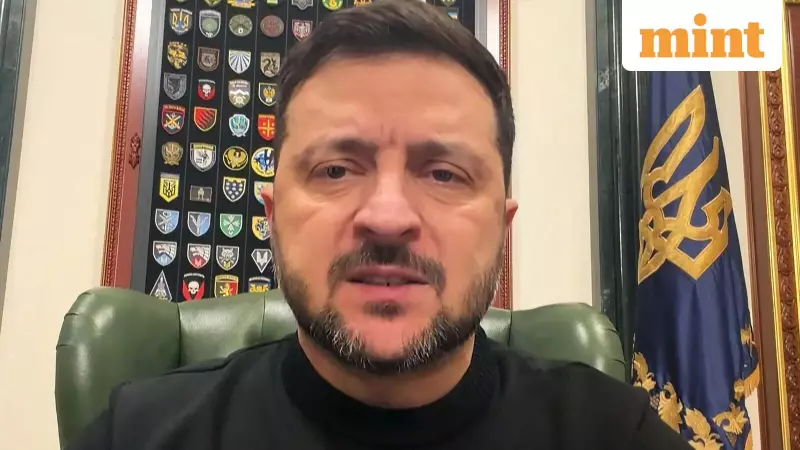
Ukrainian President Volodymyr Zelensky has publicly disclosed the specifics of a comprehensive new peace proposal, negotiated with Washington and now awaiting feedback from Moscow. The 20-point plan outlines a potential roadmap to end the ongoing conflict, covering critical areas from security guarantees and territorial arrangements to massive reconstruction funding and a mechanism for a ceasefire.
Core Framework: Sovereignty, Ceasefire, and Monitoring
Speaking to journalists in Kyiv, President Zelensky stated the document reaffirms Ukraine's sovereignty and establishes a "full and unconditional" non-aggression pact between Ukraine and Russia. A key feature is a proposed monitoring mechanism that would use space-based unmanned surveillance to oversee the line of contact, provide early warnings of any violations, and help resolve disputes.
The plan stipulates that an immediate full ceasefire would take effect once all parties agree to the proposal.

Security, Military, and Economic Pillars
Under the proposed terms, Ukraine would maintain a peacetime armed force of 800,000 personnel. Crucially, it would receive security guarantees from the United States, NATO, and European signatories that mirror NATO's Article 5 collective defence principle.
Zelensky explained these guarantees would trigger a coordinated military response and the reinstatement of all global sanctions if Russia attacks Ukraine again. However, the guarantees would become void if Ukraine initiates an unprovoked attack on Russian territory.
On the economic front, the plan commits to Ukraine joining the European Union within a defined timeframe, with short-term privileged access to the EU market. A separate global development package envisages a Ukraine Development Fund and large-scale reconstruction of war-affected regions.
Massive Reconstruction Funds and Nuclear Plant Plan
President Zelensky highlighted that the proposal includes multiple recovery funds. A notable one is a US-European capital and grants fund targeting $200 billion for transparent post-war reconstruction investment.
On a critical security issue, the plan states that the Zaporizhzhia Nuclear Power Plant would be jointly operated by Ukraine, the United States, and Russia. Ukraine would also reaffirm its status as a non-nuclear state under the Nuclear Non-Proliferation Treaty.
Territorial Lines, Elections, and Enforcement
The document de facto recognises current troop deployment lines in Donetsk, Luhansk, Zaporizhzhia, and Kherson as the line of contact. For the agreement to take effect, it calls for Russian forces to withdraw from Dnipropetrovsk, Mykolaiv, Sumy, and Kharkiv regions.
A humanitarian committee would oversee an all-for-all prisoner of war exchange and the return of detained civilians and children. The plan mandates that Ukraine hold elections as soon as possible after the agreement is signed.
Zelensky said the deal would be legally binding, with implementation monitored by a Peace Council chaired by US President Donald Trump. Sanctions would be imposed for any violations.
The Ukrainian leader acknowledged that consensus was not reached on long-term territorial arrangements and the Zaporizhzhia plant's future, leaving these for leaders-level talks. He also confirmed the draft does not require Ukraine to formally renounce NATO membership. Kyiv is now awaiting Moscow's response after the US conveys the proposal to Russian officials.






