

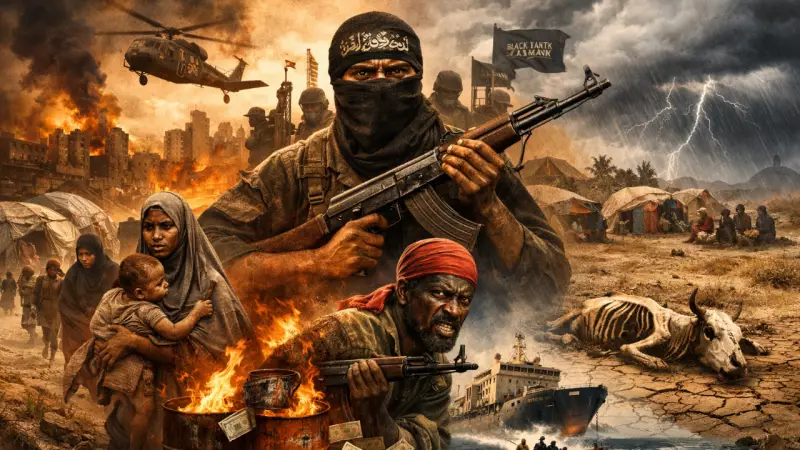
While recent global headlines have briefly turned towards Somalia due to events in the United States, the nation's true story is far deeper and more complex, rooted in its own soil. For over seven decades, the Horn of Africa nation has endured cycles of turmoil that rarely receive sustained international focus. The simplistic label of a "failed state" fails to capture the intricate layers of unresolved conflict, climate-induced disasters, chronic poverty, mass displacement, and persistently fragile governance that define modern Somalia. Each crisis feeds into the next, creating a vicious cycle where drought leads to hunger, hunger fuels violence, and the absence of a strong state allows armed groups to flourish.
The Historical Unraveling: From Hope to Chaos
Following World War II, Somalia experienced a period of promise under British and Italian administration. The union of British Somaliland and Italian Somalia in 1960 gave birth to the Republic of Somalia, beginning as a parliamentary democracy. This optimism was brutally cut short on October 21, 1969, when Major General Mohamed Siad Barre seized power in a military coup. Barre's 22-year dictatorship proclaimed socialism, switched alliances between the Soviet Union and the United States, and grew increasingly repressive. His campaign to dismantle Somalia's traditional clan structure empowered a small elite and led to horrific violence, including the 1988 bombardment of northern cities that killed up to 200,000 civilians, primarily from the Isaaq clan.
By 1991, Barre was overthrown by allied clan militias, plunging the country into civil war. The central government vanished, and factional fighting triggered a man-made famine in 1992. A failed international peacekeeping mission, marked by the 1993 "Black Hawk Down" incident in Mogadishu, led to a global withdrawal. The 1990s saw no functional national government. Regions like Somaliland and Puntland formed their own administrations. In this vacuum, local Islamist sharia courts gained popularity, eventually uniting in 2006 as the Islamic Courts Union (ICU), which briefly controlled Mogadishu. The Ethiopian military intervention that ousted the ICU gave rise to its most violent offshoot: the Al-Qaeda-linked militant group, Al-Shabaab.

Clan Politics, Governance Vacuum, and Enduring Threats
Clan dynamics have been the constant undercurrent of Somalia's politics. The post-2012 political system institutionalized this through the "4.5 formula", allocating parliamentary seats and top government positions among major clans. As noted by sources like the CIA World Factbook, MPs are often selected through clan elder agreements rather than universal suffrage. This system ensures no government has a truly national mandate. Federal institutions remain weak, struggling to control territory beyond the capital. Large rural areas are under the control of clan militias or Al-Shabaab, which remains a potent force, described by the Council on Foreign Relations as one of Al-Qaeda's strongest affiliates.
The group wages a relentless guerrilla war, with conflict-related deaths reaching a decade-high in late 2022. Its frequent suicide bombings in Mogadishu and raids into neighboring Kenya and Ethiopia perpetuate a severe security crisis that stifles economic growth and humanitarian aid. Parallel to this land-based terror, maritime lawlessness emerged as Somali piracy, which hijacked hundreds of ships between 2005 and 2012 at its peak. While international patrols curbed major incidents, the underlying drivers—poverty and impunity—persist, with sporadic attacks continuing off the Puntland coast.
Human Cost and a Fragile Future
The socioeconomic toll is devastating. Somalia's economy, with a GDP of only about $13 billion (PPP), relies heavily on livestock, remittances, and aid. The government collects minimal tax revenue. An estimated 52-54% of Somalis live in poverty, with youth unemployment rampant. This hardship has triggered massive displacement: over 714,000 Somali refugees live abroad, while nearly 4 million are internally displaced.

On paper, there has been incremental progress, such as the formation of the Federal Government in 2012 and Somalia's first inclusion in the UN's Human Development Index in July 2024. However, the fundamental challenges are interlocked. 80% of the population struggles to meet daily needs amidst recurring droughts and floods. The presence of 20,000 African Union troops (AMISOM) and international aid has not translated into sustainable stability without deep domestic governance reform. Somalia's plight is a stark warning: decades of fractured politics and unresolved conflict have turned manageable stresses into permanent, overlapping emergencies. The path forward requires moving beyond short-term fixes to address the entrenched cycles of clan rivalry, extremism, and economic despair that have defined the nation for generations.





