

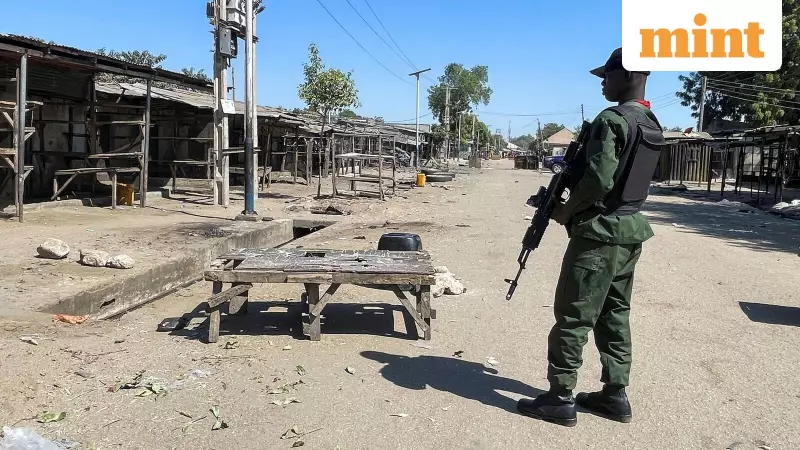
In a significant military escalation, the United States has executed what it describes as "powerful and deadly" airstrikes targeting Islamic State (ISIS) militants in northwest Nigeria. The action, announced by US President Donald Trump via social media on Thursday, marks a direct intervention in Nigeria's complex security landscape, driven by claims of extremist violence against Christian communities.
Timeline of Escalating Tensions
The recent military action is the culmination of weeks of rising diplomatic friction between Washington and Abuja. The sequence of events began in late October.
On October 31, 2025, President Trump designated Nigeria as a "Country of Particular Concern" under US law. He asserted that Christianity faced an "existential threat" in the nation, blaming "Radical Islamists" for the killing of thousands of Christians.

By November 2, the rhetoric intensified. Trump threatened to cut off all American aid to Nigeria and instructed the Pentagon to prepare for potential military action. In a social media post, he warned of going "guns-a-blazing" into the country to "completely wipe out" the terrorists if the Nigerian government did not act swiftly.
Between November 2 and 4, Nigerian officials firmly rejected Trump's characterization of the situation. President Bola Tinubu's administration defended Nigeria's record on religious freedom, stating the claims did not reflect the national reality. A spokesperson clarified that Nigeria was open to US security assistance, provided its territorial integrity was respected.
On November 19, Nigeria's Minister of Information and National Orientation, Mohammed Idris Malagi, provided further context in an interview with Al Jazeera. He acknowledged security challenges from violent extremism but stressed that attacks generally did not discriminate based on religion. "Christian communities and Muslim communities have been attacked by these extremists," Malagi stated, calling Trump's focus on Christian persecution a misunderstanding of Nigeria's complex dynamics.
The Airstrikes and Conflicting Narratives
The decisive action came on December 25. US forces conducted precision airstrikes in Nigeria's northwest. President Trump framed the operation as a direct response to ISIS attacks on Christians, part of efforts to counter an "existential threat" to these communities.
However, Nigeria's official response presented a different emphasis. The country's foreign ministry confirmed the strikes were carried out as part of ongoing security cooperation with the United States, involving intelligence sharing and strategic coordination. In a post on X, the ministry stated this partnership "has led to precision hits on terrorist targets in Nigeria by air strikes in the North West." This framed the action as a collaborative counter-terrorism effort rather than a unilateral US move driven by sectarian concerns.
Understanding Nigeria's Security Landscape
The backdrop to these events is Nigeria's protracted and multifaceted security crisis. With a population of approximately 220 million people, almost evenly split between Muslims and Christians, the country faces insurgencies from several groups.
The most prominent threat has long been Boko Haram, a jihadist group seeking to establish a harsh interpretation of Islamic law. While often targeting Christians, Boko Haram has also killed many Muslims it considers insufficiently devout. The Islamic State's West Africa Province (ISWAP), an ISIS affiliate, is also active in the region and was likely the target of the US strikes.
The Nigerian government's consistent position has been that the violence is primarily driven by terrorism and banditry, not religious war, though sectarian tensions can be exploited by militants.
The US airstrikes represent a major new front in American military engagement in Africa. While the tactical objective of degrading ISIS is shared by both nations, the underlying political narratives diverge sharply. The situation highlights the delicate balance between international counter-terrorism support and respect for national sovereignty, all set against the volatile backdrop of Nigeria's internal conflicts.






