

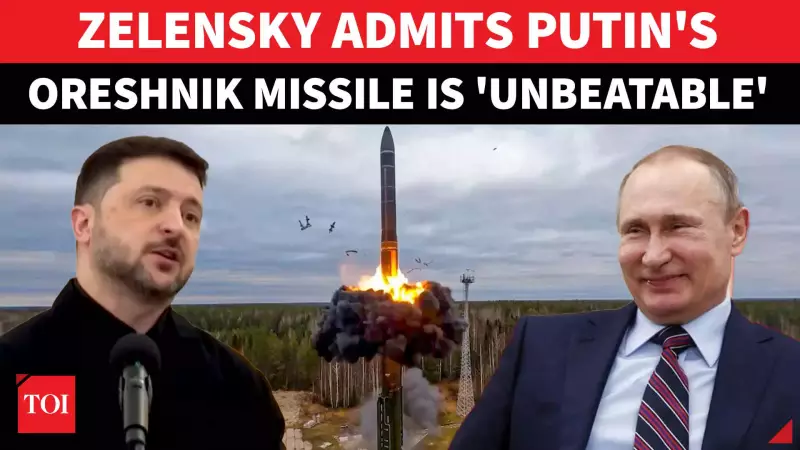
Ukrainian President Volodymyr Zelensky has made a significant and concerning admission regarding Russia's military capabilities, sounding a major alarm for European security. During a visit to Warsaw, Zelensky stated that Ukraine's current drone defences are unable to shoot down Russia's advanced Oreshnik missile system.
Direct Threat to NATO Nations from Belarus
Speaking alongside Polish President Karol Nawrocki on December 20, 2025, Zelensky confirmed that the Oreshnik system is now on active combat duty in Belarus. He framed this deployment as a direct security threat to several European nations, explicitly naming Poland and Germany. The Ukrainian leader emphasised that the war in his country is not an isolated conflict but a direct test of Europe's long-term defensive resolve.
Zelensky revealed that Kyiv has already shared critical intelligence with its Western allies. This intelligence includes the precise location of the Oreshnik systems and details about their operational strike range. The sharing of this data is seen as an urgent call for a coordinated response.

Call for Tougher Sanctions on Supply Chains
Beyond the military warning, President Zelensky pushed for stronger economic measures against Russia. He specifically urged Western partners to impose tougher sanctions on companies that are supplying critical missile components to Moscow through third countries. This highlights ongoing challenges in fully isolating Russia's military-industrial complex from global supply networks.
The Ukrainian president connected the survival of his nation directly to the future security of Central Europe. He issued a stark prediction, warning that without a secure and independent Ukraine, Moscow would "inevitably come for Poland" next. This statement aims to frame the conflict as a frontline battle for the entire continent's safety, not just Ukraine's sovereignty.
Implications for NATO and European Security
Zelensky's public admission about the limitations of Ukrainian air defences against the Oreshnik system marks a crucial moment. It underscores a shifting battlefield dynamic where Russian missile technology may be gaining an edge. The placement of these systems in Belarus extends Russia's potential strike capability deeper into NATO's eastern flank, fundamentally altering the regional security calculus.
The appeal made in Warsaw is clear: the West must respond not only with continued military support for Ukraine but also with more aggressive efforts to cripple Russia's ability to produce such advanced weaponry. The coming weeks will likely see increased diplomatic pressure regarding sanctions enforcement and potentially new discussions on enhancing NATO's own air defence posture in member states bordering Belarus and Russia.






