

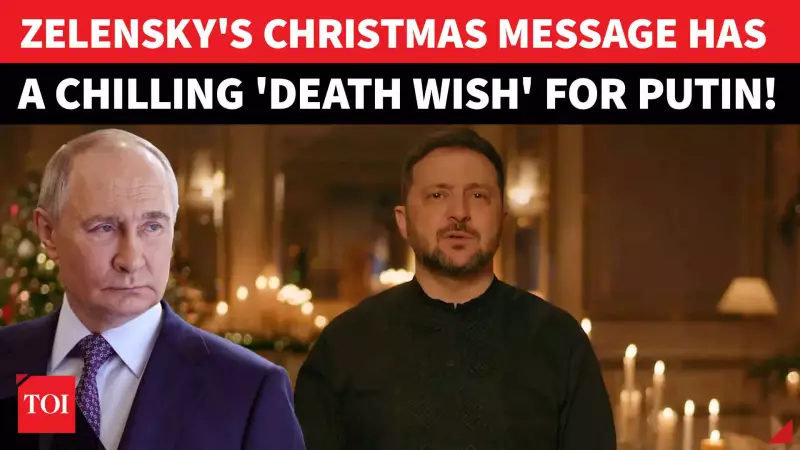
Ukrainian President Volodymyr Zelensky's annual Christmas address has triggered a fierce international discussion following a veiled remark widely understood as a desire for the death of Russian President Vladimir Putin. Delivered on Christmas Eve, the message contained a line that has since been dissected and debated across global media platforms.
The Cryptic Phrase That Shook The World
In his festive message to the nation on December 24, 2025, President Zelensky invoked an old folk belief that wishes made on Christmas night possess a special power to come true. He stated that all Ukrainians currently share "one dream" and "one wish." The President then concluded this thought with the stark, three-word phrase: "May he perish."
While Zelensky did not explicitly name Vladimir Putin, the context of the ongoing, brutal conflict between Ukraine and Russia left little doubt about the intended subject for most interpreters. The statement was immediately picked up by news agencies and has become the focal point of his entire holiday message.

Context of Continued Conflict and Stalled Diplomacy
This provocative comment comes at a time of continued military engagement along the front lines and a complete stall in peace negotiations between Kyiv and Moscow. The war, which has raged for years, shows no sign of a diplomatic breakthrough, with both sides entrenched in their positions.
The Ukrainian leader's message underscores the profound national sentiment of resistance and the dire circumstances faced by his country. Analysts suggest the language reflects the immense pressure and frustration stemming from the prolonged conflict and the significant human cost endured by Ukraine.
International Reactions and Ramifications
The "may he perish" line has predictably drawn a spectrum of reactions. While some view it as a raw expression of a nation's desperate hope for an end to a war instigated by the Russian leader, others see it as an undiplomatic and escalatory rhetoric from a head of state.
The Kremlin has yet to issue an official response to this specific part of the speech, but it is likely to be condemned as further evidence of what Moscow calls Kyiv's "anti-Russian" stance. The incident adds another layer of complexity to any future peace talks, which were already at a standstill.
This episode highlights how wartime communications, especially during emotionally charged periods like holidays, can transcend traditional diplomatic language and carry significant symbolic weight. Zelensky's choice of words, rooted in a cultural tradition of Christmas wishing, has transformed into a powerful political statement heard around the world.






