

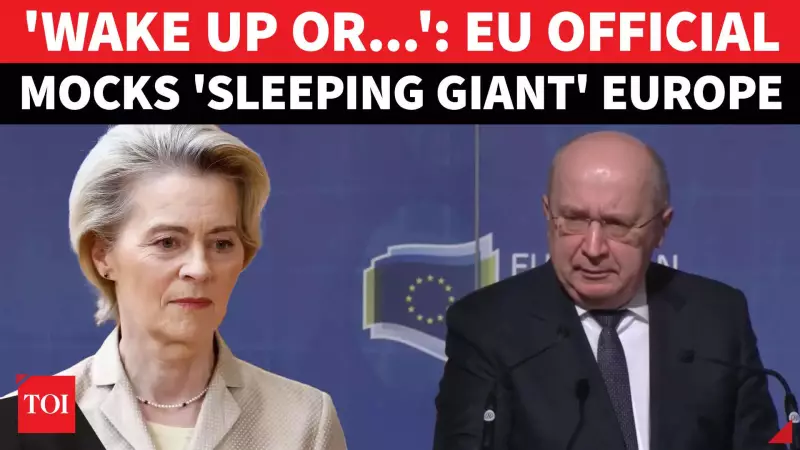
EU Commissioner Sounds Alarm on Europe's Military Future, Calls Bloc a 'Sleeping Giant'
In a stark warning that has sent ripples across the continent, European Union officials are raising urgent alarms about Europe's military preparedness and future security. The message is clear and uncompromising: Europe must wake up from its slumber and take decisive action to defend itself in an increasingly volatile world.
'Ukraine War Exposes Defence Weakness'
Speaking at the European Defence Agency's annual conference in Brussels, EU Commissioner for Defence and Space Andrius Kubilius delivered a blunt assessment of Europe's current defence posture. He described Europe as a "sleeping giant" that has been relying too heavily on spending alone to guarantee its security.
The commissioner emphasized that lessons from Ukraine's ongoing war demonstrate a crucial reality: "Money without integration, production capacity, and shared strategy delivers little real deterrence." This statement highlights a fundamental flaw in Europe's approach to defence, where financial investments have not translated into effective military capabilities.

The Urgent Need for Military Unity
Kubilius's warning comes at a critical juncture for European security. As the United States shifts its strategic focus away from Europe, Brussels is pushing for several key initiatives:
- Pan-European defence capabilities that transcend national borders
- Deeper alignment with NATO structures and objectives
- Faster industrial coordination across member states
- Enhanced production capacity for military equipment and technology
The commissioner stressed that fragmentation among European nations could leave the continent dangerously exposed to potential adversaries. He argued that without greater unity and coordination, Europe's defence efforts remain inefficient and insufficient to meet emerging threats.
A Strategic Shift in European Defence Thinking
This warning represents a significant shift in how European leaders are approaching defence matters. For decades, many European nations have relied on American military protection through NATO. However, changing global dynamics and the lessons from Ukraine's resistance against Russian aggression have forced a reevaluation of this approach.
The conference in Brussels served as a platform for this crucial discussion, bringing together defence officials, military experts, and industry leaders to address Europe's security challenges. The consensus emerging from these discussions points toward a more integrated, self-reliant European defence architecture.
The Path Forward for European Security
Kubilius outlined several concrete steps that Europe must take to strengthen its defence posture:
- Accelerate military integration beyond current cooperation frameworks
- Develop shared strategic objectives that align national interests with collective security
- Boost defence industrial production to reduce dependence on external suppliers
- Enhance rapid response capabilities across the continent
The commissioner's message carries particular weight given his position overseeing defence and space matters for the European Union. His warning reflects growing concerns among European leaders about the continent's vulnerability in a world where traditional alliances are being tested and new security challenges are emerging.
The ultimate takeaway from this important conference is unambiguous: Europe must prepare to defend itself collectively or risk being tested by adversaries who may perceive current weaknesses as opportunities. The time for action is now, before geopolitical realities force Europe into a reactive rather than proactive position on the global stage.

