

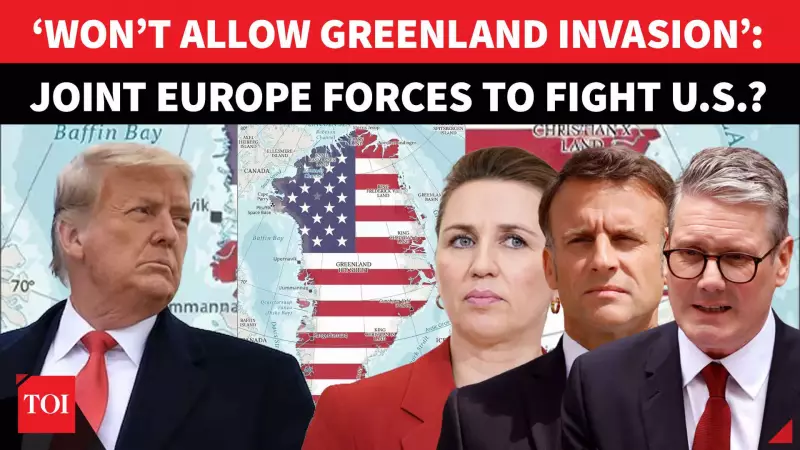
In a significant show of diplomatic unity, Europe has firmly closed ranks against former US President Donald Trump's renewed rhetoric about acquiring Greenland. The coordinated response, issued on January 6, 2026, underscores growing tensions among traditional allies over unilateral power plays in the strategically vital Arctic region.
A Coordinated European Rejection
The United Kingdom, Denmark, and six other European nations delivered a synchronized message, explicitly rejecting any external claims over the self-governing island. The statements, while avoiding direct confrontation with Trump, left no room for misinterpretation. European leaders collectively stressed that Greenland's future is a matter solely for its people and the Kingdom of Denmark. They framed the issue not just as a territorial question, but as a fundamental matter of sovereignty, alliance unity, and the security architecture of NATO.
The core of Europe's message was unambiguous: Greenland is not a bargaining chip. This firm stance highlights the continent's commitment to the principles of territorial integrity and international law, even when challenged by a powerful ally like the United States.

The Arctic: A New Geopolitical Flashpoint
This dispute gains urgency against the backdrop of the rapidly changing Arctic landscape. As climate change opens up new sea routes and access to vast untapped resources, the region's geopolitical and military significance has skyrocketed. Control or influence over Greenland, the world's largest island, offers a commanding position in the North Atlantic and the Arctic.
Europe's swift and unified reaction signals its deep unease with the prospect of unilateral actions that could destabilize the delicate balance in the region. The move is seen as a preemptive measure to deter any potential unilateral power plays that might treat sovereign territory as a commodity.
Implications for Transatlantic Relations
The episode exposes underlying fractures and anxieties within the Western alliance. While Europe and the US have long been partners, Trump's transactional approach to foreign policy and his revival of the Greenland topic—first floated during his presidency—has triggered alarm. The European statement is a defensive maneuver, aimed at reinforcing established norms and alliances in the face of unpredictable shifts in American policy.
By drawing this firm diplomatic line, European capitals are making it clear that certain foundational principles are non-negotiable, regardless of who occupies the White House. The dispute underscores that the Arctic's future will be shaped not just by resource competition, but by a complex tug-of-war between sovereignty, alliance politics, and great power strategy.

