

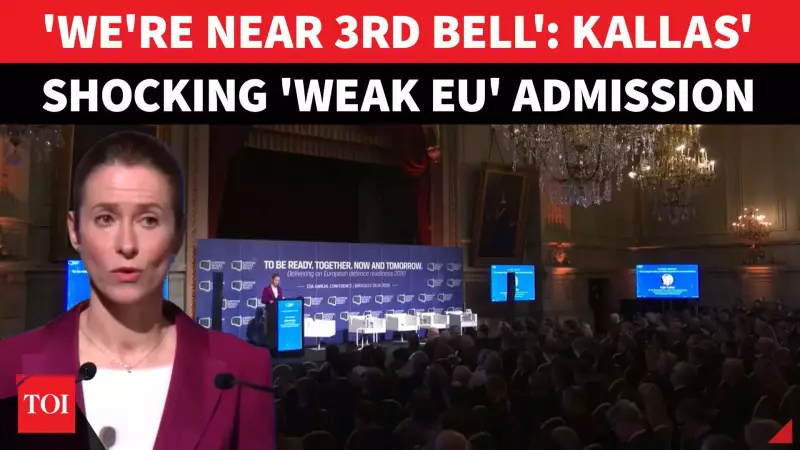
EU's Kallas Sounds Alarm on NATO, Admits Europe Faces Critical Moment
In a stark warning that has sent shockwaves through diplomatic circles, European Commission Vice-President Kaja Kallas has delivered a blunt assessment of Europe's security future. Speaking at the European Defence Agency's annual conference in Brussels, Kallas declared that the transatlantic relationship is undergoing a deep and irreversible shift that demands immediate European action.
The "Third Bell" Analogy: Europe Running Out of Time
Using a powerful "third bell" analogy, Kallas emphasized that Europe is rapidly approaching a moment of reckoning. She argued that as the United States strategically reorients its focus beyond the European continent, European nations cannot afford to delay critical decisions about their own security architecture.
"No great power survives by outsourcing its security," Kallas stated unequivocally, highlighting what she sees as Europe's dangerous over-reliance on American military protection. Her comments come at a particularly sensitive time as the United States appears to be distancing itself from what some American policymakers have characterized as a "slow" Europe.

Urgent Calls for Defence Integration and NATO Reform
Kallas outlined several concrete proposals for how Europe should respond to this changing security landscape:
- Accelerated defence integration among European Union member states
- Faster military decision-making processes to respond to emerging threats
- Greater European responsibility within NATO structures
- Limiting national vetoes through qualified majority voting on defence matters
- Increased military support for Ukraine in its ongoing conflict
Toward a European Defence Union
Perhaps most significantly, Kallas raised the prospect of a future European Defence Union, signaling what could represent a historic reordering of Europe's security architecture. This vision suggests a more autonomous European defence capability that could operate alongside, but not entirely dependent on, NATO structures.
The timing of Kallas's remarks is particularly noteworthy, coming as the United States under the Trump administration has repeatedly questioned the value of traditional alliances and emphasized a more transactional approach to international relations. Her admission that Europe must fundamentally rethink its security posture represents a significant departure from decades of transatlantic orthodoxy.
European defence experts are now debating whether Kallas's warnings will spur concrete action or remain rhetorical. What is clear is that the traditional security assumptions that have governed European defence policy since the Cold War are being fundamentally challenged from multiple directions simultaneously.

