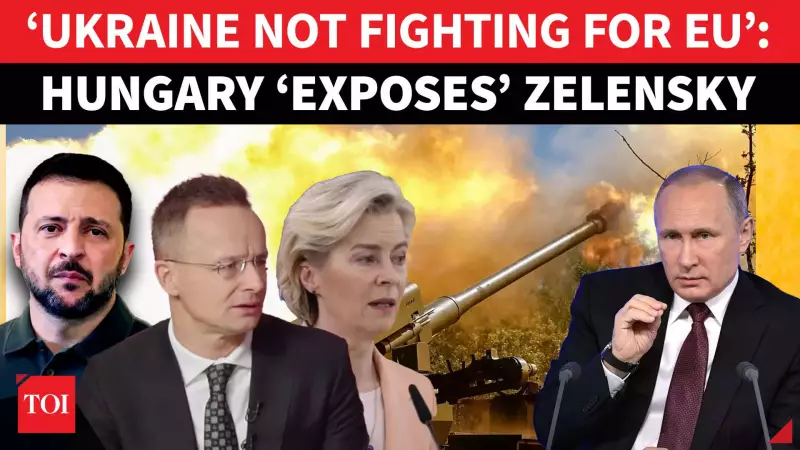
In a blistering critique that has sent shockwaves through European capitals, Hungary's Foreign Minister Peter Szijjarto has labelled the continent's prevailing logic on the Ukraine conflict as an "outrageous lie". Speaking candidly on the 'Hour of Truth' podcast in Budapest, the top diplomat asserted that Kyiv is fighting solely for its own survival and not as a proxy for Europe's defence.
Europe's 'Outrageous Lie' and Kyiv's True Motives
Peter Szijjarto pulled no punches during his podcast appearance, directly challenging the narrative that has guided billions in Western military aid to Ukraine. He stated that the idea Europe is helping Ukraine as a form of collective self-defence against Russia is fundamentally false. "Kyiv was fighting for itself and not for Europe," Szijjarto declared, stripping away the geopolitical justification often used by EU and NATO leaders.
This stark assessment from a sitting EU minister highlights the deep and growing fissures within the bloc regarding the strategy and endgame of the now prolonged war. Hungary, under Prime Minister Viktor Orban, has consistently been the most vocal sceptic of unconditional support for Ukraine.

A Dire Warning: 'NATO Won't Survive' and a 'Mood of War'
The Hungarian minister issued a grave warning about the potential consequences of the current trajectory. He cautioned against the dangerous "mood of war" he sees enveloping the European Union. This mood, he suggested, is being fuelled by specific proposals currently on the table in Brussels.
Szijjarto pointed to two contentious EU plans in particular:
- The initiative to use seized Russian frozen assets to fund Ukraine's war effort.
- A proposal to limit the size of the Ukrainian army to 800,000 soldiers.
He framed these moves not as steps toward peace or stability, but as escalations that risk drawing the continent into a broader, more catastrophic conflict. His comments included the stark prediction that "NATO won't survive" a full-scale war with Russia, a statement meant to jolt European policymakers into reconsidering their approach.
Showing Europe the Mirror on Strategic Blunders
By calling out what he terms Ukrainian President Volodymyr Zelensky's "bluff," Szijjarto aims to force a strategic reckoning. His argument posits that European leaders, in their zeal to support Kyiv, are failing to see the conflict realistically and are ignoring the severe existential risks to their own security architecture.
The interview, recorded on December 16, 2025, serves as a powerful diplomatic broadside. It comes at a critical juncture as debates over continued funding for Ukraine and the legality of using frozen Russian state assets reach a fever pitch within the EU. Hungary's position sets up a formidable roadblock to any consensus, promising further political turmoil in the coming months.
Ultimately, Peter Szijjarto's message is one of stark realism versus what he perceives as European idealism. He is holding up a mirror to the EU, urging it to abandon a policy he believes is based on a false premise and is steering the continent toward a precipice. The fallout from this candid warning will likely reverberate in diplomatic circles for weeks to come.