

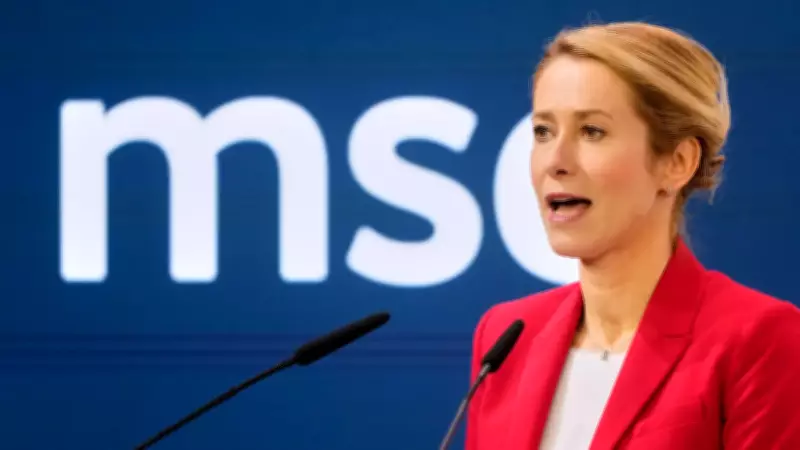
Europe's Kallas Firmly Rejects Civilisational Threat Narrative, Calls for Stringent Russia Conditions
In a robust address at the Munich Security Conference on Sunday, Estonia's Prime Minister and Europe's top diplomat, Kaja Kallas, delivered a firm rebuttal to recent commentary from the United States, explicitly stating that Europe is not under any civilisational threat. She simultaneously advocated for imposing significantly tougher conditions on Moscow as part of any potential peace deal for Ukraine.
"No Civilisational Erasure": Kallas Counters US Rhetoric
Directly addressing remarks made by US officials, Kallas declared, "Contrary to what some may say, woke, decadent Europe is not facing civilisational erasure." Her statement served as a pointed response to US Secretary of State Marco Rubio's Saturday address, where he spoke of revitalising the "greatest civilisation in human history" and warned Europe to defend against mass migration to protect its "civilisation."
Kallas acknowledged the existing differences in perspective between the transatlantic partners, noting, "It is also clear that we don't see eye to eye in all the issues, and this will remain the case." However, she underscored the enduring nature of the alliance, adding, "The message that we heard is that America and Europe are intertwined, have been in the past and will be in the future. I think this is important."

Demanding Accountability: A Hard Line on Russia
Shifting focus to the ongoing conflict, Kallas struck a sharply critical tone towards Russia, describing it as "no superpower" and "broken." She emphatically argued that Russia must not be allowed to gain diplomatically what it failed to achieve through military force.
Outlining her vision for a just peace, the Estonian leader insisted that any settlement must include strict limitations on Russia's military capabilities, enforceable obligations for Moscow to pay comprehensive war damages, and mechanisms to hold it accountable for documented war crimes. She reinforced the strategic imperative, stating that European defence "starts in Ukraine."
European Echo: Calls for Strategic Focus and Rearmament
Kallas's stance found resonance with other European leaders present at the conference. France's Europe Minister, Benjamin Haddad, echoed her call for a pragmatic focus, urging European nations to concentrate less on political rhetoric from Washington and more on concrete actions to bolster their own defence industrial base and military readiness.
Haddad warned against complacency, advising, "Focus on what we can control, focus on our rearmament, on the support for Ukraine and the threat that Russia poses to all of our democracies." This sentiment aligns with Kallas's broader argument for European strategic autonomy and resilience in the face of persistent threats from Moscow.
The exchanges at the high-profile security forum highlight the nuanced dynamics within the transatlantic alliance, where shared fundamental goals coexist with differing assessments of threats and priorities. While affirming the indispensable bond with the United States, European leaders like Kallas are clearly articulating a distinct European perspective on security, sovereignty, and the necessary terms for lasting peace in Eastern Europe.

