

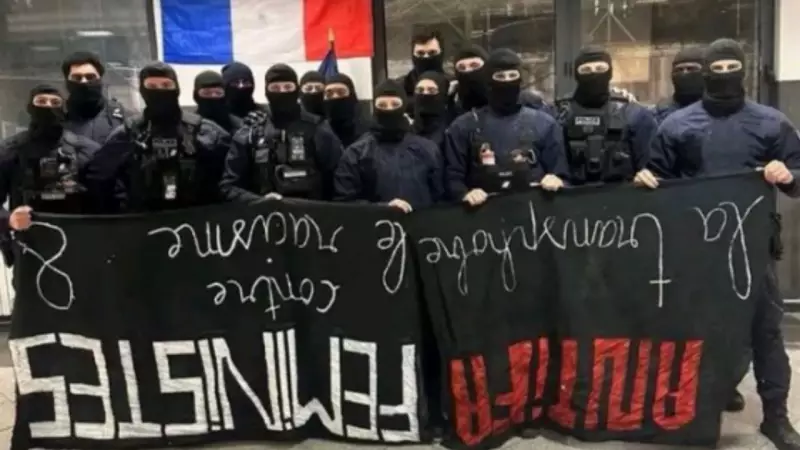
Authorities in Paris have initiated a formal investigation following the emergence of a controversial photograph showing police officers posing behind a confiscated feminist and anti-fascist banner that had been deliberately turned upside down.
Image Sparks Immediate Outcry and Investigation
The image, first published by the online outlet Blast, is reported to have been taken inside a police station. It depicts about two dozen uniformed officers with their faces concealed by hats and neck gaiters, standing behind a black banner. The banner, which reads “Antifa Feminists against transphobia and racism” in red and white lettering, was seized during a demonstration in Paris against sexual and gender-based violence on November 22.
In a swift response, the Paris police headquarters confirmed to the AFP news agency that it had “immediately opened an investigation” after the photo began circulating on social media. The probe focuses on the conduct of officers from one of its units seen holding the banner in an inverted position.

Political Condemnation and Allegations of Bias
The incident has drawn sharp criticism from left-wing politicians in France. Jean-Luc Mélenchon, leader of the hard-left France Unbowed (LFI) party, strongly condemned the officers' actions. He stated that while individual officers dishonouring their uniform was one issue, the silence of the police hierarchy and the lack of internal dissent were more telling.
“That there isn’t a single police officer who dares express their disagreement tells us a great deal about the danger women face from such individuals,” Mélenchon said.
This episode has reignited longstanding accusations from human rights groups and left-wing factions in France. They have repeatedly charged the French police force with exhibiting right-wing bias and racism. The police institution, however, consistently denies these systemic allegations. It maintains that any misconduct by a few individuals does not reflect the values or behaviour of the force as a whole.
Broader Implications for Police Conduct
Blast, in its report, highlighted that the posture of the hooded officers in the photo resembled behaviour often associated with hooligan circles—groups the police are typically tasked with confronting. This juxtaposition has added fuel to the debate over police culture and accountability in France.
The investigation now underway will seek to determine the circumstances under which the photo was taken, identify the officers involved, and decide on appropriate disciplinary measures. The outcome is being closely watched by activist groups and political observers alike, as it touches upon sensitive issues of political neutrality, respect for protest symbols, and professional conduct within law enforcement.






