

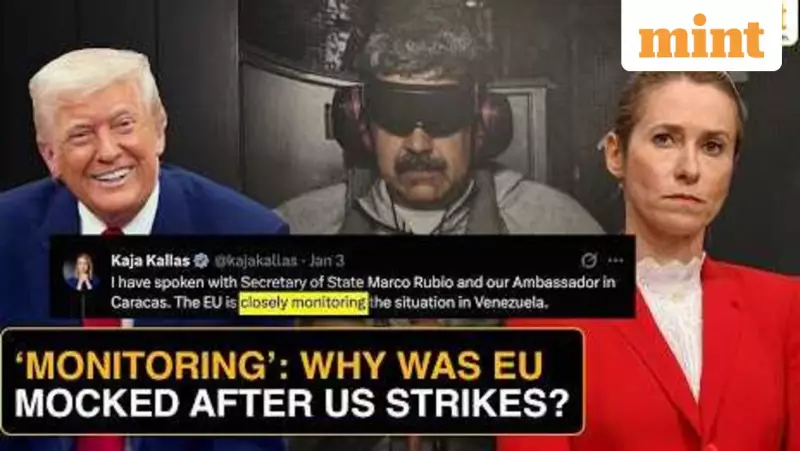
The European Union's diplomatic response to a dramatic geopolitical event has ignited a firestorm of criticism and mockery across social media platforms. The incident unfolded after United States forces captured Venezuela's President Nicolas Maduro, a move that sent shockwaves through international relations.
A Tepid EU Statement Draws Immediate Flak
In the wake of the high-stakes operation, the European Union issued a formal response. Rather than taking a decisive stance, the bloc stated it was 'closely monitoring' the evolving situation in Venezuela. This cautious, boilerplate language, often used by diplomatic bodies, was perceived by many as weak and ineffective given the gravity of the event.
The statement, released shortly after the news of Maduro's capture broke, did not outline any concrete actions, sanctions, or strong political support. It positioned the EU as a passive observer in a crisis that involved a major Western ally directly intervening in the affairs of a South American nation. This perceived inaction became the focal point for widespread derision.

Social Media Erupts with '#UselessEU' Taunts
Almost instantly, the phrase 'Useless EU' began trending on platforms like X (formerly Twitter), Facebook, and others. Users from around the world, including many from India commenting on global governance, piled on with memes, sarcastic remarks, and sharp critiques.
Common themes in the mockery included:
- Comparing the EU's 'monitoring' to inaction during other international crises.
- Contrasting the EU's verbal stance with the direct military action taken by the US.
- Questioning the purpose and power of the Union as a geopolitical actor if its primary tool is observation.
Experts and political commentators also joined the fray, suggesting that the response undermined the EU's ambition to be a cohesive foreign policy player. They argued that such cautious rhetoric in the face of a bold American move highlights the bloc's internal divisions and lack of a unified, proactive strategic doctrine for hard power scenarios.
Broader Implications for EU's Global Role
The backlash points to a larger, ongoing debate about the European Union's role on the world stage. The Venezuela crisis, updated as of January 5, 2026, serves as a case study in the perception gap between the EU's self-view as a normative power and how its actions are interpreted by the global public.
This episode suggests that in an era of rapid, dramatic conflicts, traditional diplomatic language like 'closely monitoring' may no longer suffice to satisfy public and expert expectations for leadership. The reaction underscores a demand for clearer, more decisive communication and action from transnational bodies like the EU, especially when core allies are involved in volatile situations.
The digital ridicule, while seemingly superficial, reflects genuine scrutiny of the mechanisms and effectiveness of international institutions. It places pressure on the EU to re-evaluate how it projects power and responds to real-time crises, lest it be permanently branded as a passive entity in the eyes of the connected world.

