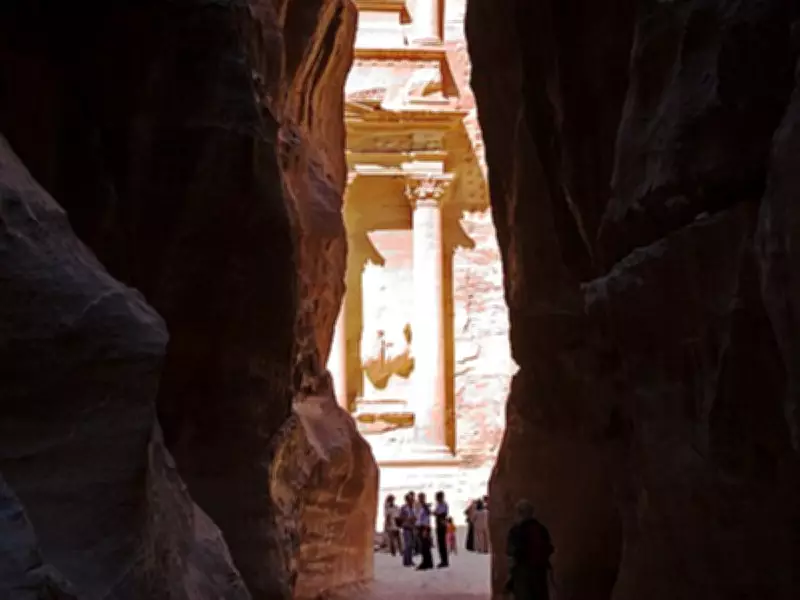
Petra remained little known to the Western world for centuries. For centuries, the ancient city of Petra was a ghost story told by local Bedouin tribes who zealously guarded its location. This magnificent archaeological wonder, carved into the deep pink sandstone cliffs of the desert, was little described in reliable Western accounts until 1812, when Burckhardt reached and recorded it.
The Merchant of India
Johann Ludwig Burckhardt was not an ordinary European traveller. Burckhardt was born in Lausanne, but the cited source says he was the son of a wealthy Swiss silk merchant; it does not say he was born into a wealthy family. He went to England in his early twenties and obtained a job with the African Association, a London-based organisation devoted to mapping the interior of the African continent. Burckhardt knew that to get ready for a dangerous expedition to the source of the River Niger, he would have to blend in with the cultures of the Middle East.
He spent years in London and Cambridge studying Arabic and Muslim customs. In 1809 he went to Aleppo in Syria. To avoid attracting the attention of the locals, Burckhardt travelled under the name Sheikh Ibrahim Ibn Abdallah, posing as a Muslim merchant. He grew a long, respectable beard and dressed in traditional loose-fitting Turkish robes. He even learned to write his private travel diaries surreptitiously, under his cloak or turban, when no one was looking.

Whisper in the Wilderness
In the beginning of 1812, Burckhardt started his journey from Aleppo southwards to Cairo. He took the more hazardous, less travelled inland route through the desert of Transjordan instead of the safer coastal roads. It was during this trek through Kerak that he started hearing local rumours of immense, spectacular ancient ruins, hidden deep in a narrow, inaccessible mountain valley.
In a historical overview of his journey published by the University of Cambridge, Burckhardt found that these ruins were very close to the biblical tomb of Aaron, the brother of Moses, which was on top of a mountain peak. The local Bedouins, deeply suspicious of European travellers, regarded them as treasure hunters or sorcerers who might steal gold or curse the land.
Burckhardt had to be smart. He hired a local guide and, under the pretence of being Muslim, claimed he had taken a sacred oath to sacrifice a goat at Aaron's tomb. Convinced of his piety and desire to honour the prophet, the guide agreed to lead the disguised Swiss explorer into the mountain pass.
Walking into the Pink Canyons
On August 22, 1812, Burckhardt went with a local guide into a narrow, gloomy chasm, which is now called the Siq. They came suddenly out of the dark passage, and the canyon opened out. It was a colossal monument, cut directly into the sheer face of the cliff, and inspiring awe. It was Al-Khazneh (the Treasury), a well-preserved monumental façade with large columns and Hellenistic ornamentation.
Burckhardt was surprised. He walked through a lost city of temples and tombs and a vast theatre, all hewn from the living rock. But, as the detailed record of his journal notes in the Linda Hall Library archive reveals, Burckhardt suspected immediately that this magnificent valley was the legendary ancient capital of the Nabataean Kingdom, which thrived roughly between the 4th century BCE and the 2nd century CE.
A Quick Getaway
Burckhardt could not tarry to admire his discovery. The guide grew suspicious of the explorer as he looked at the monuments. He shortened his exploration, finished his goat sacrifice, and pushed on to Cairo, afraid of being unmasked as an infidel and robbed of his journals.
He died of dysentery in Cairo in 1817, aged 33, before making the journey to West Africa that he had planned. His surviving letters and journals were published in 1822 and introduced Petra to the Western scholarly world.