

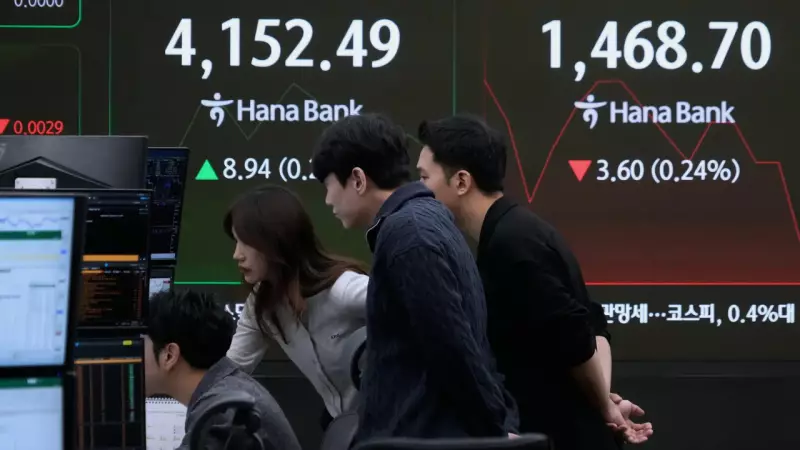
Asian stock markets experienced widespread declines on Monday, with Japan leading the downturn as a strengthening yen dealt a significant blow to export-oriented companies. The region's financial landscape remained cautious amid ongoing currency fluctuations, uncertainty surrounding United States trade policies, and anticipation of a crucial Federal Reserve policy announcement later this week.
Japanese Market Plunges as Yen Rebounds Against Dollar
Japan's benchmark Nikkei 225 index fell sharply by 1.8 percent to settle at 52,870.15 points, dragged down by heavy selling in major exporting corporations. Toyota Motor Corporation shares dropped approximately 4 percent, reflecting the broader market sentiment. The sell-off followed a notable rebound in the Japanese yen against the US dollar, reversing the currency advantage that typically supports Japanese exporters by enhancing the value of their overseas earnings.
The dollar slipped to 154.27 yen from 155.01 yen, marking a significant retreat from last week's trading near 158 yen. This currency movement came after comments from Japanese and American officials indicated close coordination on exchange rate fluctuations, fueling market expectations of potential intervention to bolster the yen.

"Intervention chatter did the trick. Since Friday, the yen has staged a sharp rebound on expectations that Japanese authorities — possibly with US coordination — would step in," noted Ipek Ozkardeskaya, senior analyst at Swissquote, in comments reported by the Associated Press.
Mixed Performance Across Regional Markets
Other Asian markets displayed varied performance amid the cautious trading environment. South Korea's Kospi index slipped 0.7 percent to 4,955.79, while Hong Kong's Hang Seng edged down less than 0.1 percent to 26,735.54. In contrast, China's Shanghai Composite managed a modest gain of 0.1 percent, closing at 4,141.31.
Several major markets remained closed for holidays, including Australia, New Zealand, India, and Indonesia, contributing to reduced trading activity across the region.
US Futures Decline Amid Trade Policy Concerns
United States stock futures edged lower, reflecting persistent uncertainty surrounding Washington's tariff policies. Futures contracts for both the S&P 500 and Dow Jones Industrial Average declined by 0.3 percent each. Investor nerves were rattled by renewed trade tensions after former US President Donald Trump threatened imposing 100 percent tariffs on Canadian goods if Ottawa pursued a free trade agreement with China.
Canadian Prime Minister Mark Carney responded firmly, stating that Canada had no plans for such an agreement with China, highlighting the ongoing diplomatic friction in North American trade relations.
Wall Street Ends Previous Week With Mixed Results
On Friday, US markets closed with mixed performance. The S&P 500 inched up less than 0.1 percent to 6,915.61 but recorded its second consecutive weekly loss. The Dow Jones Industrial Average fell 0.6 percent to 49,098.71, while the Nasdaq Composite gained 0.3 percent to 23,501.24.
Most stocks declined during the session, with Intel Corporation plunging 17 percent and weighing heavily on the broader market, according to Associated Press reports. Investors are now turning their attention to the US Federal Reserve's policy meeting scheduled for Wednesday, where interest rates are widely expected to remain unchanged.
Commodities Rally as Investors Seek Safe Havens
In commodity markets, oil prices edged higher with US benchmark crude rising 43 cents to $61.50 per barrel and Brent crude gaining 48 cents to $65.55 per barrel. Precious metals surged significantly as investors sought safer assets amid market volatility.
Gold climbed 2 percent to exceed $5,100 per ounce, while silver jumped 7 percent to $108.39 per ounce, extending gains observed over recent months. This movement toward traditional safe-haven assets underscores the cautious sentiment prevailing across global financial markets.






