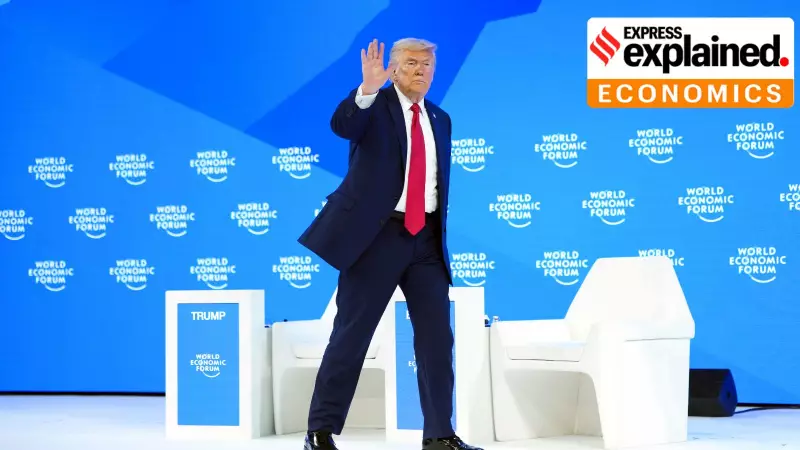
In a notable shift, former President Donald Trump has recently withdrawn tariff threats against Greenland and European allies, reigniting discussions around the so-called TACO effect—a pattern where economic escalations are swiftly reversed following market downturns. This phenomenon, observed multiple times over the past year, underscores how financial markets influence presidential policy decisions.
The Greenland Episode and Market Response
Trump's revival of long-standing threats to invade Greenland, an autonomous Danish territory, initially elicited little reaction from markets, even amid heightened geopolitical tensions. However, last week's escalation, including fresh tariff proposals against eight European nations unless they supported a U.S. purchase of Greenland, triggered significant volatility. On January 20, three major U.S. stock indexes—the Dow, S&P 500, and Nasdaq—experienced their first substantial declines since October, with drops of 1.8%, 2%, and 2.4%, respectively.
This market downturn coincided with European resistance, including promises of retaliatory measures. In response, Trump adopted a more conciliatory tone at the World Economic Forum in Davos, announcing a productive meeting with NATO Secretary-General Mark Rutte and backing off the tariff threats. This sequence exemplifies the TACO effect, where economic threats are de-escalated in the face of market rejection.

Origins and Evolution of the TACO Effect
The term TACO, short for Trump Always Chickens Out, was coined by Financial Times commentator Robert Armstrong in May 2025. It emerged from analysis of Trump's tariff announcements, such as the April 2025 baseline 10% tariff on all trading partners, which was later relaxed. Armstrong noted that market adaptations—like stock declines and gold price increases—signaled low tolerance for economic pressure within the administration, leading to quick reversals.
This pattern has repeated throughout Trump's second term. For instance, in May 2025, threats to raise EU tariffs to 50% were reversed after discussions with European leaders, sparking a market rally. Similarly, in October 2025, proposed 100% tariffs on Chinese imports following Beijing's export controls led to a massive selloff, prompting a backtrack and a comprehensive deal announced in November.
Market Dynamics and Investor Opportunities
A year into Trump's second term, markets have increasingly factored in the TACO effect, viewing tariff threats as temporary bluster. This has created lucrative opportunities for investors, such as shorting S&P 500 futures upon threat announcements and buying back later. A 2025 Nomura study highlighted returns of up to 12% since February 2025 using this strategy, outperforming passive stock holdings.
However, the TACO effect carries risks akin to the boy who cried wolf parable. As noted by University of Massachusetts Economics Professor Arin Dube, if markets become desensitized to threats, Trump might escalate until a genuine crisis catches investors off guard. This underscores the delicate balance between market psychology and policy credibility.
Global Implications and European Retaliation Risks
The Greenland tariff threats highlighted broader trade tensions, with Europe holding significant leverage. The EU could invoke retaliatory tariffs, use the Anti-Coercion Instrument for export controls, or sell off U.S. assets, potentially devaluing the dollar and increasing U.S. living costs. Yet, such actions would also harm European economies, given their $8 trillion in U.S. bonds and stocks, illustrating the interconnected risks in global trade.
In summary, the TACO effect reveals how market reactions can drive policy reversals, shaping investor strategies and international relations. As geopolitical and economic escalations continue, understanding this dynamic remains crucial for stakeholders worldwide.