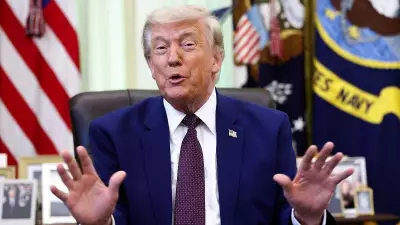
In a surprising twist to the ongoing economic tensions, former US President Donald Trump's advocacy for a significantly weaker US dollar is finding an echo in an unlikely quarter: China. While a major dollar devaluation against the yuan did not materialise in 2025, financial giants like Goldman Sachs are flagging it as a critical factor to watch in 2026, with some analysts estimating the Chinese currency could be undervalued by as much as 30%.
The Economic Logic Behind a Weaker Greenback
President Trump has long argued that a strong dollar hurts American exports and tourism. "You make a helluva lot more money with a weaker dollar," he stated in July 2025, claiming that a robust currency makes it difficult to sell everything from tractors to trucks abroad. His goal is clear: diminish the competitive edge of Chinese goods and reduce the massive US trade deficit.
However, Trump noted that resistance to this rebalancing comes from trade partners like China and Japan, whom he accuses of preferring weak currencies to boost their own exports. Despite his rhetoric, his administration held back from aggressive measures like officially labelling China a currency manipulator in 2025.

China's Calculated Control and the Undervalued Yuan
Currently, Beijing maintains tight control over the yuan's value. As China's annual trade surplus soared above $1 trillion, the currency was held at just above 7 to the dollar by the end of 2025. While stronger than the 7.3 level at the start of the year, it remains about 7% weaker than five years ago.
Experts explain that in a free market, such a persistent trade surplus would naturally strengthen the yuan. Instead, Chinese authorities purchase excess dollars and reinvest them in assets like US Treasury bonds, deliberately keeping their currency competitive. Logan Wright of Rhodium Group notes that China's trade policy is fundamentally geared towards maximising its global export market share.
This strategy has led to a significant undervaluation, according to several analyses. Brad Setser of the Council on Foreign Relations and Goldman Sachs analyst Teresa Alves have separately estimated the yuan's undervaluation against the dollar at 20% to 30%. Alves has marked a potential yuan rise in 2026 as one of her "highest conviction views."
A New Debate: Could a Stronger Yuan Make China Great?
Intriguingly, a growing chorus of influential Chinese economists is beginning to argue that real global power requires a strong, internationally accepted currency, much like the US dollar or the British pound of the past. They see a stronger yuan as a path to turbocharging domestic consumption and escaping economic stagnation.
Liu Shijin, a top government adviser, pointedly observed that Trump's ability to wield tariffs effectively stems from the buying power of dollar-wielding American consumers. He argued that China, with its vast population, should rightfully hold that "whip hand." Liu advocates for a basic trade balance and pushing for a strong, globally used currency so that "Chinese consumers can use the same amount of renminbi to enjoy more high-quality, affordable international products."
This view was echoed by former People's Bank of China official Sheng Songcheng, who suggested in November 2025 that a fair exchange rate to balance purchasing power could be as strong as 4 or 5 yuan to the dollar, not the current 7.
Despite this emerging debate, official resistance to a rapid yuan appreciation remains high in Beijing, haunted by the memory of Japan's post-Plaza Accord economic bubble and lost decades. As Rhodium's Wright summarises, moving away from the export-led growth model would require navigating a "very sharp slowdown in growth," a fundamental and difficult choice for China's leadership.