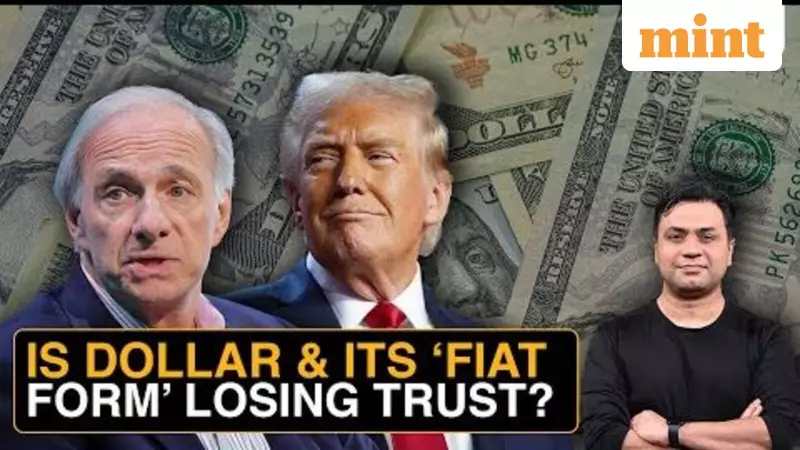
The US Dollar's Existential Crisis: How Fiat Currency Faces a Credibility Challenge
In the complex world of global finance, the concept of fiat money stands as a cornerstone of modern economies. Fiat currency, such as the US Dollar or the Euro, is government-issued money that lacks backing by physical commodities like gold. Instead, its value hinges entirely on trust in the issuing government and the dynamics of market supply and demand. This system, while functional for decades, is now under unprecedented strain, leading to what experts term an existential and credibility crisis for the US Dollar.
The Fragile Balance of Trust and Supply
The stability of fiat currencies relies on a delicate equilibrium. On one side, governments must manage currency supply responsibly, avoiding excessive printing that can devalue money. On the other, geopolitical stability is crucial to maintain investor confidence. However, this balance is breaking down. Persistent concerns over geopolitical risks, coupled with aggressive monetary policies, have eroded the foundational trust in fiat systems. When a government continually prints more currency to address debts or stimulate economies, it risks triggering inflation and undermining the currency's purchasing power, creating a vicious cycle of devaluation.
BRICS and the Push for De-dollarisation
Amid these challenges, the BRICS alliance—comprising Brazil, Russia, India, China, and South Africa—has emerged as a significant force advocating for de-dollarisation. This movement seeks to reduce global reliance on the US Dollar in international trade and reserves, promoting alternative currencies or a new financial framework. The motivations are multifaceted, including desires for greater economic sovereignty, reduced exposure to US monetary policy, and geopolitical maneuvering. As BRICS nations explore mechanisms like local currency settlements or digital currencies, the US Dollar's dominance faces a tangible threat, accelerating its credibility crisis.

Implications for Global Finance and Debt
The crisis extends beyond mere currency valuation, impacting global debt structures and economic stability. The US, with its towering national debt, relies heavily on the Dollar's status as the world's primary reserve currency to finance obligations. If de-dollarisation gains momentum, it could increase borrowing costs, strain fiscal policies, and trigger currency wars as nations compete for financial influence. This scenario underscores the urgency for reforms, whether through principles like those advocated by Ray Dalio, emphasizing diversification and resilience, or through international cooperation to stabilize fiat systems.
In summary, the US Dollar's role as a fiat currency is at a crossroads, challenged by internal pressures like debt and external shifts like BRICS-led de-dollarisation. Addressing this crisis requires a reevaluation of monetary policies and global trust mechanisms to prevent further erosion of financial stability.