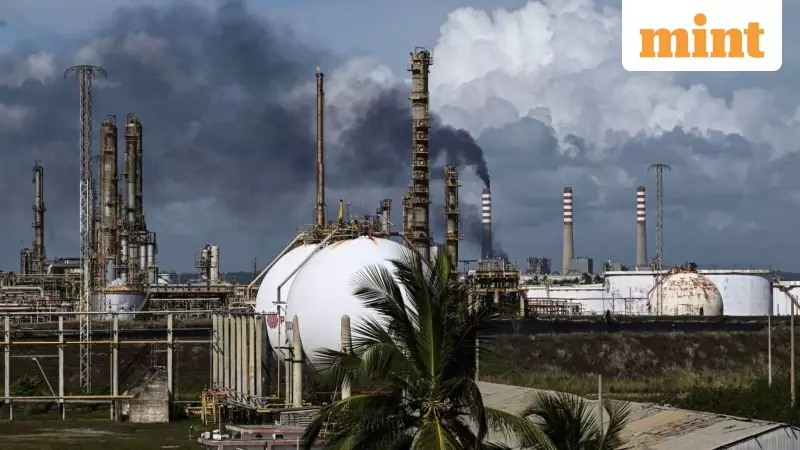
Venezuela Proposes Oil Industry Reforms to Attract Foreign Investment
Venezuela's interim government has introduced a significant hydrocarbons bill designed to loosen the state's stringent control over the country's beleaguered oil sector. The proposed legislation, unveiled on Thursday, aims to attract much-needed foreign investment, particularly from U.S. energy companies, as the nation seeks to revive its crippled production capabilities.
Key Provisions of the Hydrocarbons Bill
The bill, expected to be approved by Venezuela's National Assembly next week, would grant private companies greater autonomy to operate oil fields and export crude through contracts with the state-owned Petróleos de Venezuela (PdVSA). This move represents a departure from the current oil law, which prohibits private entities from independently exploring, producing, and exporting petroleum resources.
Notable changes include:

- Codifying into law the previously opaque productive participation contracts that were implemented under former leader Nicolás Maduro to circumvent U.S. sanctions
- Maintaining a 30% royalty rate while allowing the government to reduce it to 15% in certain joint ventures
- Permitting independent arbitration to resolve disputes, though without specifying whether proceedings would occur abroad
Political Context and International Pressure
The reform comes amid significant political upheaval following the January 3 raid in which U.S. commandos removed strongman Nicolás Maduro from power. President Trump has since pressed American producers to invest approximately $100 billion in Venezuela's oil industry, with only Chevron currently holding an operational license in the country.
"We're going to take back the oil that, frankly, we should have taken back a long time ago," Trump stated after Maduro's capture, framing the approach as reversing the nationalization policies implemented by Maduro's predecessor, Hugo Chávez.
The Trump administration hopes increased Venezuelan production could help lower U.S. oil prices to $50 per barrel, potentially reducing gasoline costs during an election year.
Analyst Skepticism and Industry Concerns
Despite the proposed changes, oil analysts and industry executives remain skeptical about the bill's ability to attract substantial new investments. Many experts argue the reforms don't provide sufficient legal certainty for companies to commit the tens of billions of dollars needed to revitalize Venezuela's production, which collapsed from over three million barrels daily before Chavismo to just 300,000 barrels in 2020.
Critical perspectives include:
- Francisco Monaldi of Rice University's Baker Institute called the legislation "a very deficient law" that continues to grant excessive discretion to the executive branch
- Exxon CEO Darren Woods described Venezuela as currently "uninvestable" without more comprehensive legal and commercial reforms
- Orlando Ochoa of the Oxford Institute for Energy Studies noted the bill offers some security for existing operators but likely won't attract new players
Additional Challenges and Diplomatic Developments
The reform faces multiple obstacles beyond its legislative shortcomings. The interim government advancing these changes is considered illegitimate by the U.S. and its allies, who cite rigged elections in 2018 and 2024. This political uncertainty further deters investors concerned about legal safeguards.
Companies have also raised security concerns in a nation where armed gangs and Colombian narco-trafficking insurgencies operate freely. Energy Secretary Chris Wright confirmed the U.S. won't provide on-the-ground security to oil companies, stating they must navigate these challenges independently.
Diplomatically, the bill coincides with efforts to restore U.S.-Venezuela relations. The U.S. recently appointed Laura F. Dogu as chargé d'affaires for the Venezuela Affairs Unit, and diplomatic teams are working toward reopening the embassy in Caracas, closed since 2019.

Financial Realities and Future Prospects
Venezuelan officials revealed this week they received an initial $300 million from the U.S., which took control of 50 million barrels of Venezuelan oil earlier this month to sell on the open market. While production has rebounded to approximately 900,000 barrels daily according to OPEC, this remains far below historical levels.
Jose Ignacio Hernandez, a Venezuelan lawyer and professor at American University, suggested Washington may push acting President Delcy Rodríguez for further reforms once it becomes clear the current proposal won't draw significant investments. "All investments need a clear, simple, stable and predictable framework," he noted, "and regrettably this is not the regulatory reform that is so far introduced in this legislation."
The hydrocarbons bill represents a cautious step toward reforming Venezuela's vital oil industry, but whether it can balance domestic political concerns with international investment demands remains uncertain as the country navigates complex economic and diplomatic challenges.