

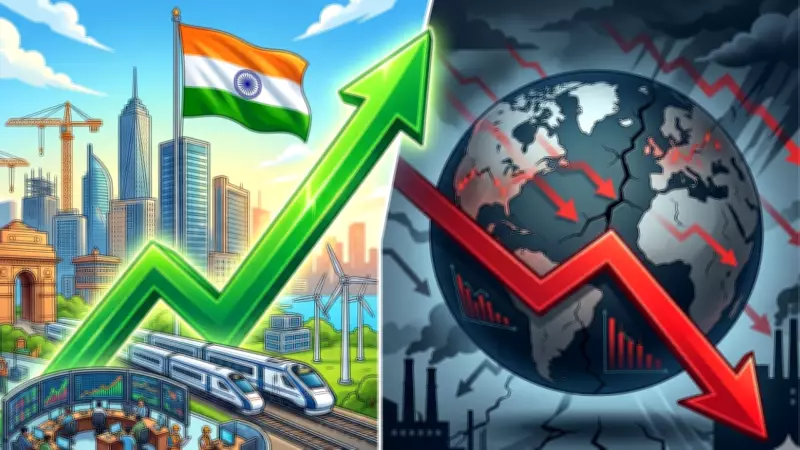
The World Bank has revised its global growth projection for 2026 downward to 2.5%, attributing the slowdown to the economic repercussions of the ongoing conflict in the Middle East, escalating energy costs, and heightened market volatility. In its latest Global Economic Prospects report, the institution cautioned that global expansion could further decelerate to 1.3% if energy supply disruptions intensify, triggering significant financial market stress.
Global Growth Trends
Global growth is anticipated to moderate from 2.9% in 2025 to 2.5% in 2026, representing the weakest pace of expansion since the COVID-19 pandemic. Despite this challenging international environment, India is projected to retain its status as the world's fastest-growing major economy. The World Bank expects India's gross domestic product (GDP) to grow by 6.6% in fiscal year 2026-27, following an estimated 7% expansion in 2025. Further projections indicate growth of 7.2% in 2027 and 7.0% in 2028.
India's Growth Outlook Amid Higher Energy Costs
The report highlights that economic activity in India remained robust during the early part of the year, underpinned by resilient domestic demand. Rural consumption has stayed strong, while urban demand is showing signs of recovery. Collections from domestic sales taxes have also continued to rise steadily. However, growth is expected to moderate as higher energy prices and rising input costs weigh on private demand. The World Bank noted that measures such as reductions in fuel taxes and lower Goods and Services Tax (GST) rates could help support consumer spending and ease inflationary pressures. Additionally, reduced US tariffs and the anticipated implementation of free trade agreements may offset weaker external demand, particularly for merchandise exports. Growth is projected to rebound over the subsequent two fiscal years, driven by stronger domestic demand and an improvement in exports.

Fiscal and External Pressures Likely to Increase
The report indicates that fiscal deficits in several South Asian economies, including India, are expected to widen due to higher subsidies aimed at cushioning the impact of rising energy prices. In India's case, lower revenues from tax reforms are likely to be partially offset by slower growth in capital expenditure and reductions in non-essential spending. The World Bank also forecasts a weakening of external balances across the region this year due to higher energy import bills and lower tourism revenues. Over the medium term, trade agreements and business-environment reforms are expected to support foreign direct investment inflows into India.
Middle East Conflict Weighs on Global Outlook
The World Bank lowered growth forecasts for two-thirds of countries as the conflict involving Iran continues to disrupt energy markets. The closure of the Strait of Hormuz has pushed up oil and gas prices, while fertiliser costs have also risen sharply, raising concerns about food supply disruptions. The lender expects Brent crude oil to average $94 per barrel this year, up 36% from 2025. It warned that if energy disruptions persist and oil averages $115 per barrel, global growth could slow to 2.1% while inflation could rise to 4.4%. "The world economy is a lot less resilient today than it was in 2008 and even as compared with 2018," Reuters quoted World Bank chief economist Indermit Gill as saying.
Emerging Economies Face Sharper Slowdown
Developing economies are expected to grow 3.6% in 2026, down from 4.4% in 2025, according to Reuters. The World Bank stated that many developing nations are confronting the prospect of a "lost decade" as progress in narrowing income gaps with advanced economies slows. China's economy is projected to grow 4.2% in 2026, down from 5% in 2025. The euro area is expected to expand by 0.8%, while Japan's growth is forecast at 0.7%. The World Bank expects global growth to improve modestly to 2.8% in both 2027 and 2028, although that would remain below the average growth rates recorded during the 2010s.






