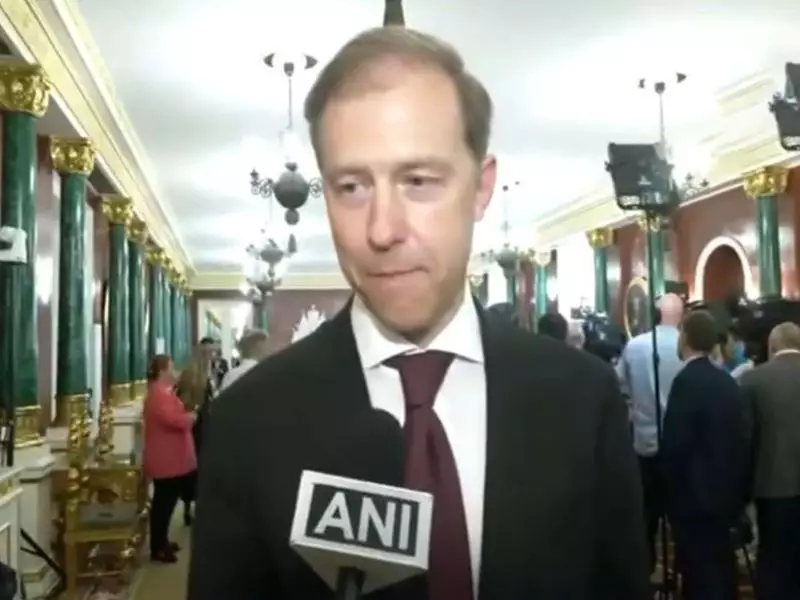
Russia has laid out a clear strategic roadmap to elevate its economic partnership with India, targeting a formidable bilateral trade goal of $100 billion. The blueprint, emphasizing diversification beyond traditional sectors, increased investment cooperation, and the wider use of national currencies, was detailed by Russian Deputy Prime Minister Denis Manturov during his recent visit to New Delhi.
Beyond Energy: A Blueprint for Diversified Trade
While energy resources have been the dominant driver of the trade surge in recent years, Manturov stressed that achieving the ambitious target requires broadening the economic horizon. The focus is now shifting towards fostering collaboration in new and promising sectors. Denis Manturov, who also serves as Russia's Minister of Industry and Trade, highlighted several key areas for expansion during his interactions at the Vibrant Gujarat Global Summit and in meetings with Indian officials like External Affairs Minister S. Jaishankar.
The proposed diversification strategy includes deepening ties in high-technology fields, civil aviation, shipbuilding, agriculture, and logistics. This move aims to create a more balanced and sustainable trade relationship that is resilient to global market fluctuations and not overly reliant on a single commodity basket.

Investment and Localization: The New Pillars of Cooperation
A central pillar of Russia's strategy to reach the $100 billion trade milestone is a significant boost in mutual investments and industrial cooperation. Manturov pointed to the critical need for joint projects in high-tech sectors and increased investment flows in both directions. The idea is to move beyond simple buyer-seller dynamics and build integrated industrial partnerships.
This involves encouraging Russian companies to localize production in India and Indian firms to explore opportunities in Russia. Such collaborations are seen as essential for technology transfer, job creation, and establishing long-term, stable economic links that go beyond transactional trade.
Navigating Financial Channels: The Rupee-Rouble Mechanism
Acknowledging the challenges posed by the current global financial architecture and sanctions pressure, Manturov underscored the importance of using national currencies—the Indian rupee and the Russian rouble—for settlements. Both nations have been actively working to establish reliable and efficient payment mechanisms to facilitate uninterrupted trade.
The deputy prime minister expressed confidence that resolving these transactional issues would unlock further growth potential. The broader use of local currency trade is viewed not just as a workaround for current challenges but as a foundational step towards greater financial sovereignty and stability in bilateral economic relations.
The push for a $100 billion trade corridor comes at a time when bilateral trade has already seen an unprecedented increase, reportedly crossing the $50 billion mark in the last financial year, primarily fueled by Russian oil exports to India. The new strategy articulated by Manturov aims to build on this momentum, transforming a quantitatively surged relationship into a qualitatively diversified and deeply integrated economic partnership.