

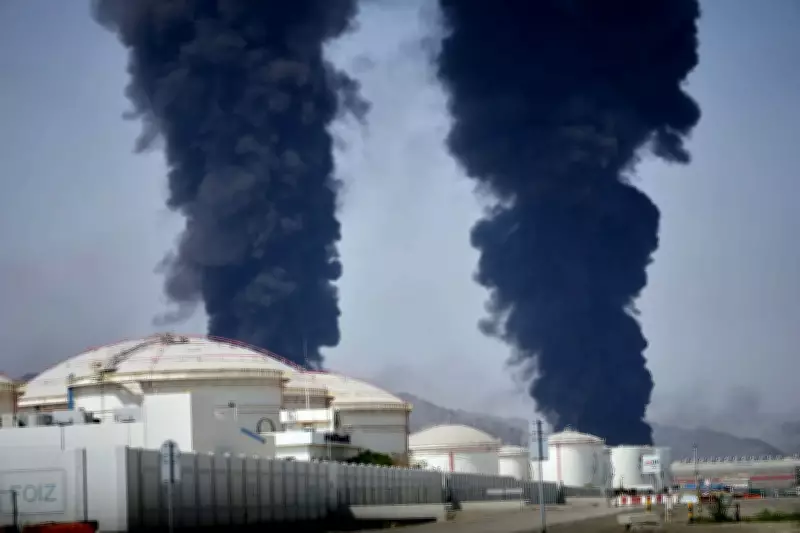
UAE's Fujairah Port Targeted in Drone Attack, Fueling Regional Tensions
The Port of Fujairah in the United Arab Emirates has been struck by a drone attack, igniting a significant fire at a petroleum facility. Specialised emergency teams responded swiftly to the incident, successfully bringing the blaze under control. Fortunately, no injuries have been reported from this latest assault.
Escalating Conflict in the Middle East
This attack occurs against a backdrop of intensifying tensions across the Middle East, as the ongoing conflict involving Iran, the United States, and Israel continues to escalate. The strike on Fujairah represents the most recent in a series of attacks targeting the port, which have previously disrupted critical oil storage and loading operations, raising alarms about regional stability.
Strategic Importance of Fujairah Port
Located on the Gulf of Oman, approximately 70 nautical miles from the Strait of Hormuz, Fujairah provides the UAE with a vital strategic alternative for oil exports. This positioning allows crude shipments to continue without reliance on the narrow and conflict-prone strait. As tensions render Hormuz largely inaccessible, Fujairah has emerged as an indispensable lifeline for international oil flows, underscoring its immense importance for both the UAE and the global energy pipeline.

Major Export and Fuel Hub
According to data from Kpler, the port exported an average of more than 1.7 million barrels per day of crude and refined fuels last year, accounting for roughly 1.7% of global daily oil demand. Additionally, Fujairah sold 7.4 million cubic metres of marine fuels in 2025, establishing it as the world's fourth-largest fuel bunkering hub, trailing only Singapore, Rotterdam in the Netherlands, and China's Zhoushan.
Critical to UAE's Oil Infrastructure
The Abu Dhabi Crude Oil Pipeline, also known as the Habshan–Fujairah Pipeline, is a cornerstone of the UAE's energy strategy. This pipeline transports crude directly from Abu Dhabi's oil fields to Fujairah, effectively bypassing the Strait of Hormuz. With a capacity of 1.5 million barrels per day, it is essential for sustaining exports, particularly to Asian markets, and enables the UAE to continue shipping its Murban crude even during regional disruptions.
Fujairah also hosts the Fujairah Oil Industry Zone, which boasts a storage capacity of 18 million cubic metres for crude and refined products—the largest commercial storage capacity in West Asia. The port supports sophisticated blending operations, where different petroleum components are mixed to produce finished products such as gasoline and bunker fuels. Major global storage and trading companies, including VTTI, Vitol, ADNOC, and Vopak, maintain significant operations at the port.
Impact on Global Oil and Fuel Markets
Any disruption at Fujairah has the potential to send ripples across the global energy market. Following the latest drone strike, some oil-loading operations have been suspended. Analysts warn that repeated attacks could tighten supply chains already strained by ongoing conflicts in the Middle East. As one of the world's premier hubs for storage, blending, and fuel bunkering located outside the Strait of Hormuz, Fujairah remains crucial not only for UAE exports but also for overall global energy stability.






