

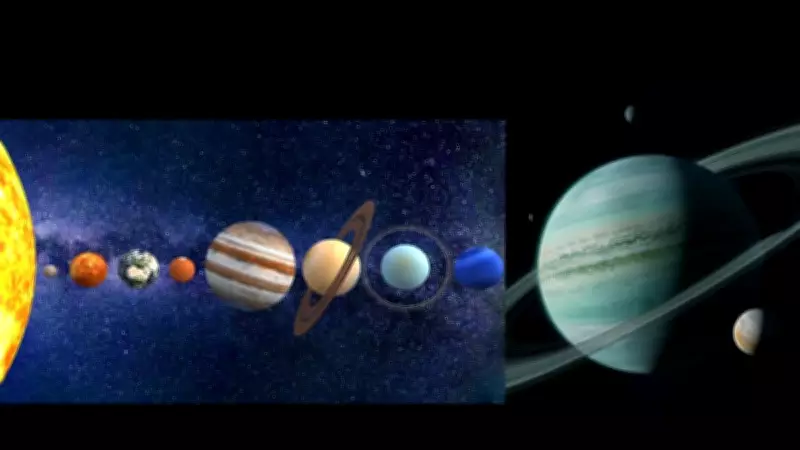
Astronomers have uncovered new hidden moons orbiting Uranus, providing fresh insights into the planet's enigmatic outer rings and the broader mysteries of our solar system. The discovery, made using advanced telescopes and imaging techniques, reveals several small, previously unseen moons that interact with Uranus's faint outer rings, shaping their structure and behavior.
Discovery Details
The research team, led by scientists from leading observatories, identified these moons by analyzing long-exposure images and data from space probes. The moons are estimated to be only a few kilometers in diameter, making them difficult to detect without sophisticated equipment. Their orbits lie within the region of Uranus's outermost rings, suggesting a dynamic relationship between the moons and the ring particles.
Significance for Planetary Science
This finding is crucial for understanding the formation and evolution of planetary ring systems. Unlike Saturn's prominent rings, Uranus's rings are dark and narrow, and their origin has long puzzled scientists. The newly discovered moons may act as "shepherd moons," gravitationally confining the ring material and preventing it from dispersing. This mechanism is similar to that observed around Saturn, where moons like Prometheus and Pandora shape the F ring.

Implications for Solar System Evolution
The presence of these hidden moons also offers clues about the history of Uranus itself. The planet's extreme axial tilt of 98 degrees suggests a violent past, possibly involving a giant impact. The moons and rings may be remnants of that collision or subsequent debris. Studying them could help researchers piece together the sequence of events that led to Uranus's current configuration.
Future Observations
Astronomers plan to conduct further observations using the James Webb Space Telescope and ground-based observatories to characterize these moons in detail. By analyzing their colors, shapes, and orbital dynamics, they hope to determine their composition and origin. This could reveal whether the moons are captured asteroids, fragments of a larger moon, or primordial material from the early solar system.
The discovery underscores the importance of continuous exploration of the outer solar system. As technology advances, more such hidden objects are likely to be found, deepening our understanding of planetary systems and their evolution.






