

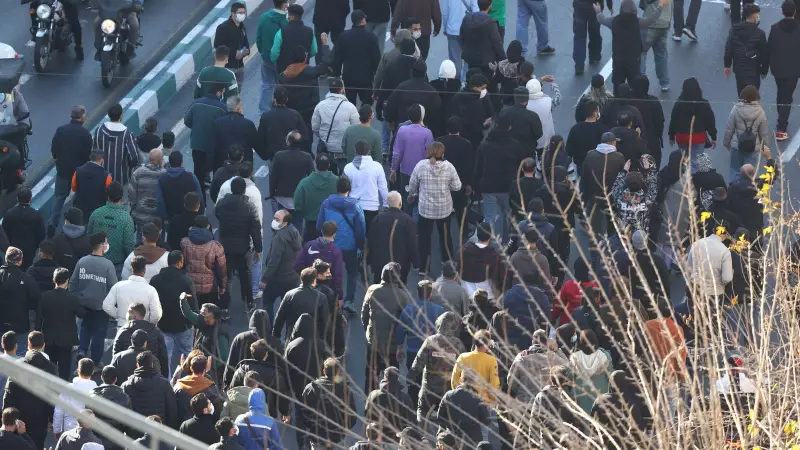
In a significant escalation of Iran's ongoing civil unrest, a volunteer member of the country's powerful paramilitary Revolutionary Guard has been killed during protests driven by a severe economic crisis. This marks the first fatality among security forces since the demonstrations began.
Death in Kouhdasht Marks a Dangerous Turn
Authorities confirmed on Thursday that a 21-year-old volunteer with the Guard's Basij force died on Wednesday night in the city of Kouhdasht, located over 400 kilometres southwest of Tehran in Lorestan province. The state-run IRNA news agency reported the death but provided few details.
Saeed Pourali, a deputy governor in Lorestan, directly blamed demonstrators for the killing. He stated the Guard member "was martyred … at the hands of rioters during protests in this city in defence of public order." Pourali added that another 13 Basij members and police officers were injured in the clashes.

Economic Despair Fuels Nationwide Discontent
The protests, which have become the largest in Iran since the 2022 Mahsa Amini demonstrations, are rooted in deep economic hardship. Pourali acknowledged this, stating, "The protests that have occurred are due to economic pressures, inflation and currency fluctuations, and are an expression of livelihood concerns."
The Iranian rial has collapsed in value, with USD 1 now costing approximately 1.4 million rials. This rapid depreciation has crushed purchasing power and ignited public anger. While the protests have slowed in the capital, Tehran, they have expanded to other provinces.
Reformist President Masoud Pezeshkian's government has signalled a desire to negotiate with protesters. However, Pezeshkian himself has conceded there is little he can do to immediately reverse the economic freefall, highlighting the limits of civilian authority in Iran's theocratic system.
State Response: Arrests, Confiscations, and a Public Holiday
The Iranian establishment appears to be pursuing a dual strategy of limited concession and increased security. Authorities declared Wednesday a public holiday across much of the country, officially citing cold weather but likely aiming to reduce crowds in urban centres during a long weekend.
Simultaneously, state television reported the arrest of seven individuals, labelling five as monarchists and two as having links to Europe-based groups. In a separate operation, security forces claimed to have confiscated 100 smuggled pistols.
The death of the Basij volunteer could prompt a more forceful crackdown by the state. Analysts fear this incident may mark the beginning of a heavier-handed response from Iran's theocracy, especially if protests intensify further.
The current wave of unrest, though significant, has not yet reached the nationwide scale or intensity of the 2022 protests triggered by Mahsa Amini's death. However, the explicit chanting against the theocracy, combined with severe economic pain, presents a sustained challenge to the regime, which is also grappling with the aftermath of a war with Israel in June and continued pressure over its nuclear program.






