

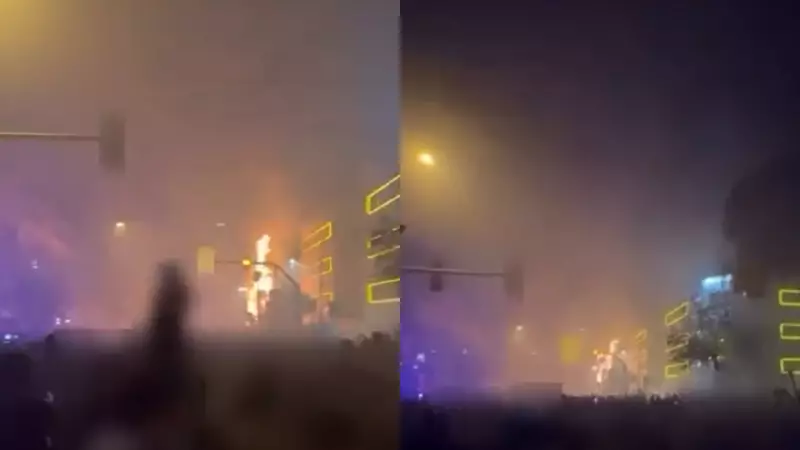
The nationwide uprising against Iran's theocratic regime has intensified, entering its twelfth consecutive day on Thursday. Demonstrators escalated their actions by setting government buildings on fire, marking a significant turn in the ongoing civil unrest.
Government Crackdown and Communication Blackout
In a drastic response to the swelling dissent, the Iranian government severed internet access and international phone services late Thursday night. This move coincided with nighttime demonstrations called for by the country's exiled crown prince, Reza Pahlavi. The internet disruption, confirmed by Cloudflare and the monitoring group NetBlocks, was a result of direct government interference. Attempts to call Iranian landlines and mobiles from places like Dubai failed to connect.
This digital blackout, a tactic previously used before severe crackdowns, left over 85 million Iranians isolated from the global internet. State television's news channel ignored the outage entirely in its Friday morning broadcast, instead focusing on food subsidies.

Mounting Toll and Roots of Discontent
The human cost of the protests is rising sharply. According to the US-based Human Rights Activists News Agency, the violence has resulted in at least 42 fatalities and the detention of more than 2,270 individuals.
The protests, which began in late December with merchants in Tehran, have rapidly evolved from demonstrations over economic hardship into broad anti-government rallies. Public fury has been simmering for years, significantly fueled by the 2022 death of 22-year-old Mahsa Amini in police custody. The current economic despair provides a potent backdrop, with Iran's currency collapse driving soaring prices for staples like meat and rice amid an annual inflation rate hovering around 40%.
Recent government policies, including raising subsidized gasoline prices and ending a preferential dollar exchange rate for most goods, threaten to push food costs even higher, exacerbating public anger.
Historical Echoes and Nightly Defiance
The calls for protest by Reza Pahlavi, son of the last Shah, evoke Iran's complex history. Decades ago, under Shah Mohammad Reza Pahlavi, Iran was a key US ally in the region. The Shah's rule was cemented by a 1953 coup in which the CIA played a role. He was ultimately overthrown in the 1979 Islamic Revolution led by Ayatollah Ruhollah Khomeini, which established the current religious dictatorship.
On Thursday and Friday, as Pahlavi's suggested protest hour of 8:00 PM local time arrived, neighborhoods across Tehran erupted. Witnesses reported crowds chanting "Death to the dictator!" and "Death to the Islamic Republic!" from windows and streets, with some voicing support for the former monarchy. Thousands poured onto the streets just before all communication channels were severed, showcasing a resilient and defiant public spirit in the face of a severe government crackdown.






