

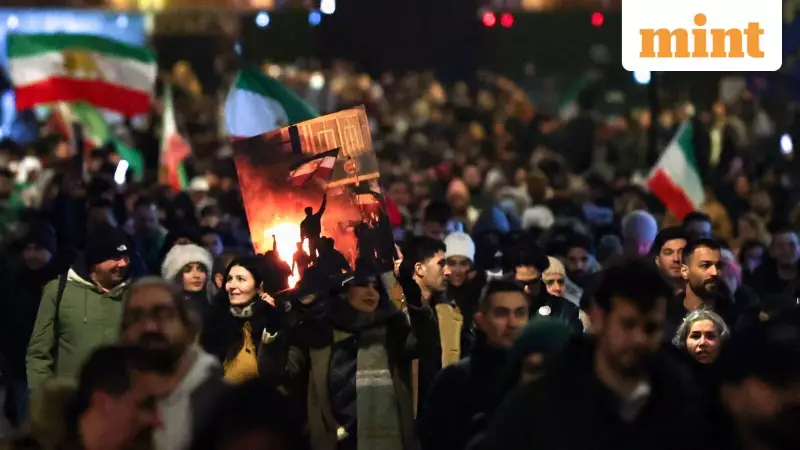
Iran's ruling clerical establishment is confronting what analysts describe as its most severe crisis in decades, weakened by a short but devastating war and now facing a nationwide protest movement that has left hundreds dead. The social contract that sustained the Islamic Republic for over four decades—citizen acquiescence in exchange for security—appears broken, pushing the country toward a dangerous and uncertain future.
The Shattered Illusion of Invincibility
The catalyst for the current upheaval was the 12-day war in June 2025 involving Iran, Israel, and the United States. For ordinary Iranians, this conflict demolished the regime's carefully cultivated image of strength and deterrence. Israeli strikes successfully targeted much of Iran's military leadership, while subsequent U.S. bombing campaigns delivered a heavy blow to its nuclear program.
This military humiliation exposed the failure of a foreign policy that invested vast national wealth into proxy networks like Hamas and Hezbollah, designed to shield the homeland. "The regime over the years had argued that although it has not been able to bring about prosperity or pluralism for the Iranians, at least it had brought them safety and security. Turns out, it didn't," said Ali Vaez, Iran project director at the International Crisis Group.

A Protest Movement Fueled by Despair
In the past two weeks, this sense of betrayal has combined with a deep economic crisis—marked by currency devaluations, declining oil prices, and strangling Western sanctions—to ignite a new wave of protests. Footage emerging from Iran shows persistent mass demonstrations despite a severe crackdown.
Assessments from human rights groups indicate that security forces have gunned down at least 500, and possibly thousands, of protesters. Unlike previous waves of dissent, current chants are not merely calling for reform but are demanding the complete downfall of the Islamic Republic itself. "Now the people have reached the point of saying: Enough is enough," Vaez added.
Karim Sadjadpour, a senior fellow at the Carnegie Endowment for International Peace, noted that the June war provided only a "temporary sugar high" of nationalist sentiment. "External wars tend to strengthen revolutionary regimes in their early years, but military humiliations expose the brittleness of late-stage dictatorships," he explained.
International Reactions and a Precarious Future
The international landscape has shifted significantly since Iran's last major protests. The United States, under President Donald Trump, is openly encouraging the unrest. Trump has repeatedly threatened to attack Iran if deadly force is used against protesters and recently posted on social media, "Iran is looking at FREEDOM, perhaps like never before. The U.S.A. stands ready to help!!!"
However, Iran's regional neighbours, including Saudi Arabia and Gulf states, hold a more cautious view. While they desire a weakened Iran, many fear the chaos of a full collapse in a nation of over 90 million, potentially sparking a Syria-style civil war with separatist movements spilling across borders. "They prefer to deal with an Iran that they know, rather than something new or a zone of instability," said Nikolay Kozhanov of Qatar University's Gulf Studies Center.
Internally, the regime, led by the 86-year-old Supreme Leader Ali Khamenei, has resisted meaningful change. It has not sought a nuclear deal to lift sanctions nor implemented major domestic reforms. This intransigence has deepened public hopelessness. "The surprise was that once you are blown up, you still want to go back to the same policies," said Alex Vatanka of the Middle East Institute.
Some analysts speculate about a potential "decapitation" strategy, where external pressure removes Khamenei, hoping for a more pragmatic successor—a template some see in the U.S. approach to Venezuela. Yet, for the protesters risking their lives, such an outcome that preserves the regime's core would render their sacrifices in vain. The coming weeks will test whether this weakened regime can survive its toughest challenge yet.






