

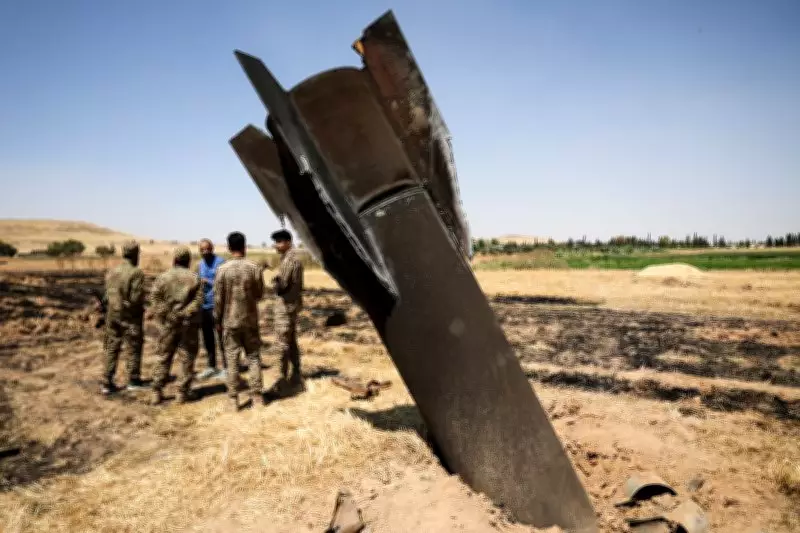
Iran announced on Wednesday that it launched a missile attack targeting an air base in Jordan that hosts US forces. The paramilitary Revolutionary Guard said it struck the Muwaffaq Salti Air Base, which has housed American F-35 fighter jets and other aircraft. Neither Jordan nor the US immediately acknowledged any attack on Jordanian territory.
This strike follows a series of escalating confrontations between Iran and the United States. Earlier, the US military conducted airstrikes on Iran after the crash of an Army AH-64 Apache attack helicopter near the Strait of Hormuz. US President Donald Trump blamed Iran for downing the aircraft, though a US official later stated that the helicopter collided with an Iranian drone, and it remains unclear whether the collision was intentional.
Retaliatory Strikes and Regional Fallout
In response to US airstrikes, Iran vowed retaliation and targeted the US Navy’s 5th Fleet headquarters in Bahrain, as well as a military base in Kuwait, according to Iranian claims. Missile alert sirens sounded in Bahrain, but neither Bahrain nor Kuwait issued official warnings about an assault. The US military’s Central Command stated that its strikes targeted “air defence, ground control stations, and surveillance radar sites” around Bandar Abbas and Qeshm Island, describing the operation as a proportional response to recent attacks on US forces and commercial shipping.

Iranian Foreign Minister Abbas Araghchi declared on social media that Iranian forces “will leave no attack or threat unanswered” and warned foreign military forces near Iranian territory to leave the region to ensure their safety. The downing of the Apache helicopter and subsequent strikes have further strained a two-month ceasefire between Iran and Israel, which had already been shaken by recent exchanges of fire. Iranian state television reported that Israeli attacks killed at least two members of Iran’s air-defense units.
Global Economic Impact
The conflict, which intensified after the US and Israel began striking Iran on February 28, has disrupted global energy markets, driving up prices and making basic commodities more expensive. The Strait of Hormuz, a critical chokepoint for oil shipments, has been effectively choked off, spiking energy costs worldwide. Efforts to turn the April ceasefire into a permanent agreement remain stalled, particularly as Israel expands its military campaign in Lebanon against the Iranian-backed Hezbollah militia.
Drone Rescue and Investigation
In a first known operation of its kind, a US drone boat rescued two aviators from the downed Apache helicopter approximately two hours after the crash. The 24-foot Corsair drone, manufactured by Saronic Technologies and assigned to the Navy’s Task Force 59, spotted and picked up the service members at 3:30 am local time. They were later transferred to a helicopter. Captain Tim Hawkins, a spokesman for US Central Command, confirmed the rescue, noting that the drone boat initially took the aviators to shore before the updated timeline was clarified.
The Apache helicopters have been a key asset for the US military in enforcing a blockade on Iranian crude oil shipments, aiming to pressure Tehran into negotiations. The drones have also been used by the UAE to shoot down Iranian drones. Task Force 59, established in 2021, focuses on uncrewed systems and artificial intelligence for maritime security in the Middle East, including the Strait of Hormuz and the Suez Canal.
Diplomatic Rhetoric and Future Risks
Trump accused Iran of shooting down the helicopter, stating that the US “must, of necessity, respond to this attack.” Araghchi countered that the Strait of Hormuz is “thousands of miles away from US shores” and warned that foreign forces near Iran’s territory are at constant risk due to human errors, accidents, or crossfire. He reiterated that the best solution for their safety is to leave the region. The ongoing tensions continue to threaten global stability and energy security.






