

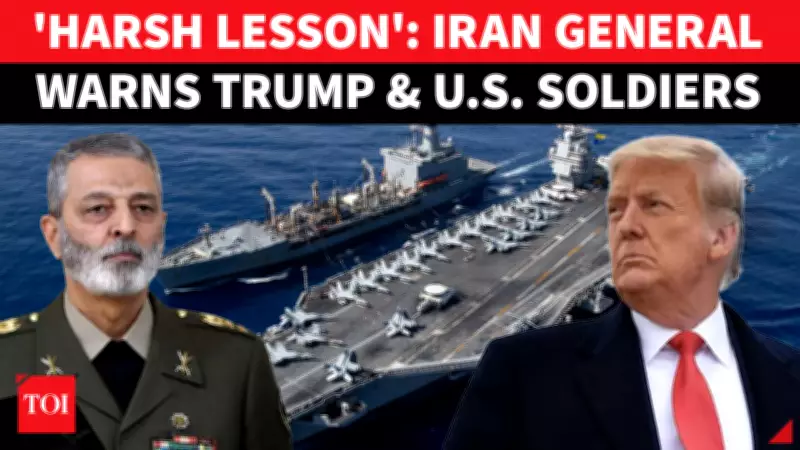
Iran's Top Military Commander Issues Stark Warning to United States
In a dramatic escalation of regional tensions, Iran's highest-ranking military official has delivered a direct and ominous warning to the United States, threatening what he termed a "harsh lesson" and deadly retaliation should the Islamic Republic come under attack. The statement from Chief of Staff Abdolrahim Mousavi comes at a critical juncture, as Washington significantly bolsters its military presence in the Middle East.
A Direct Message to President Trump
General Abdolrahim Mousavi explicitly addressed President Donald Trump, condemning recent U.S. rhetoric as reckless and provocative. The Iranian commander warned that any form of confrontation initiated by the United States would be met with severe and devastating consequences. This verbal confrontation underscores the deepening rift between the two nations, even as diplomatic channels remain partially open.
Military Buildup Amidst Diplomatic Efforts
The warning coincides with confirmed reports of the United States deploying additional aircraft carriers, ground troops, and advanced fighter jet squadrons to the Persian Gulf region. This substantial military reinforcement represents a clear signal of Washington's strategic posture and readiness. Analysts note that the movement of such assets is one of the largest in recent years, heightening fears of a potential military clash.

Despite this alarming military posturing, indirect negotiations concerning Iran's nuclear program have not been entirely abandoned. A recent round of talks was held in Muscat, Oman, with another session scheduled to take place in Geneva, Switzerland. This creates a complex and volatile situation where military pressure and diplomatic dialogue are occurring simultaneously, a dynamic that many experts find particularly dangerous.
Fears of a Renewed Regional Conflict
The current climate has sparked intense concern among international observers and regional governments. There is a growing apprehension that the escalating tensions could spiral into a renewed, large-scale conflict, reminiscent of the devastating 12-Day War in June 2025. That brief but intense conflict caused significant instability and loss across the Middle East, and its memory looms large over the present crisis.
The situation remains fluid and highly unpredictable. The international community is closely monitoring the dual tracks of military mobilization and nuclear diplomacy, aware that a miscalculation by either side could have catastrophic repercussions for regional and global security. The stark warning from Iran's military leadership serves as a potent reminder of the high stakes involved in this geopolitical standoff.






