

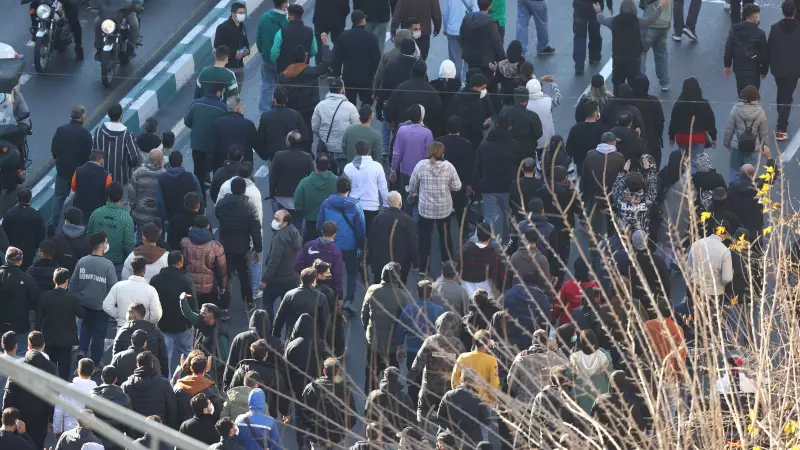
Iran is witnessing its most significant wave of nationwide unrest since the 2022 'Woman, Life, Freedom' movement, with the current protests posing a direct challenge to the clerical establishment. What began in late December 2025 as economic demonstrations has rapidly evolved into a broader political revolt, testing the foundations of the Islamic Republic.
The Spark: Economic Collapse Ignites the Bazaar
The immediate trigger for the latest upheaval was a severe currency and inflation crisis. The Iranian rial plummeted to a historic low of approximately 1.45 million rials per US dollar in late December 2025, a drastic fall from 0.82 million rials a year prior. Concurrently, inflation surged beyond 40%, crippling the purchasing power of ordinary citizens.
This economic shockwave first ignited protests among merchants in Tehran's historic Grand Bazaar, a traditional bastion of commerce and political influence. Analysts note that Bazaar traders, unable to compete with rivals benefiting from state patronage, reached a breaking point. Historically, the Bazaar's economic resilience helped the regime survive crises, including the eight-year war with Iraq. Its shift from quietism to active resistance marks a pivotal moment.

From Economic Grievance to Political Revolt
Within days, shopkeeper gatherings transformed into open protests and nighttime clashes with security forces, spreading beyond the Bazaar's confines. The protests now carry a potent political message: calls for regime change. Notably, even merchants not known for dissent are joining these demands.
The movement is amplified by a young, connected generation. Known as 'Dahe Hashtadi' (the 80s generation, born 1997-2012), they have no memory of the 1979 Revolution. Influenced by global connectivity, they demand personal freedoms and often view the pre-revolution Pahlavi era as a 'golden age' of modernization. A recurring feature of recent protests is the slogan 'Javid Shah' (Long live the Shah) and calls for exiled Crown Prince Reza Pahlavi's return.
A Regime at an Impasse: Internal Fragility and External Threats
The Iranian regime finds itself in a precarious position, grappling with a triple crisis of economic failure, international isolation, and a profound crisis of legitimacy, especially among the youth. Its ambitions for regional hegemony are constrained by internal socio-economic and generational divides.
Externally, pressure remains intense. A diplomatic deadlock persists over Iran's nuclear programme, coupled with the reinstatement of stringent UN and US sanctions. The region is on edge following the 12-day war of June 2025, with Iran anticipating new Israeli military actions. Reports suggest the Israel Defense Forces are preparing for a potential multi-front war, citing Iran's internal unrest.
Furthermore, the regime's strategic position is weakened by the fall of Bashar al-Assad in Syria and the diminished capacity of key proxies like Hezbollah and Hamas. The internal women-led protest movement continues to challenge the rigid Islamic orthodoxy, compounding the regime's troubles.
While it is uncertain whether the current revolt will escalate into a full-scale revolution, the Islamic Republic is undeniably facing one of its most severe tests in nearly five decades. The convergence of economic despair, a disaffected young population, and the loss of support from traditional pillars like the Bazaar has created a volatile mix. The regime's coercive grip on power remains, but its foundations appear more fragile than ever.






