Morning After Supreme Leader's Death Reveals Iran's Deep Divisions
The dawn of February 29th did not arrive quietly across Iran. Instead, it broke with expressions of celebration from some quarters as confirmation spread that Supreme Leader Ali Khamenei had been killed in coordinated strikes by the United States and Israel. Videos quickly circulated showing small groups, particularly women, openly celebrating the attack that also claimed Defense Minister Aziz Nasirzadeh and other senior officials.
While the targeted killings drew widespread international condemnation, reactions within Iran presented a far more complicated picture. For many citizens, the online expressions of relief were not about celebrating death itself, but rather reflected a fragile hope that this upheaval might finally trigger the profound changes long demanded across Iran's social, legal, and economic systems—especially those affecting women's rights and autonomy.
Emotional Responses from the Diaspora
Iranian-American journalist Masih Alinejad, a participant in the 2022 protests within Iran, posted an emotional video on March 1st where she visibly fought back tears, declaring, "I want to run, I want to shout." Her raw reaction captured the intensity of feeling among many in exile.

British-Iranian actress Elika Ashoori took to Instagram with a powerful statement: "My stance has always been and always will be anti-war, but I refuse to be boxed into a moral code that asks me to mourn a firing squad or not rejoice at their destruction. For 46 years, the Islamic regime has not been a government; it has been an occupying force at war with its own people, relentlessly massacring, assaulting and abusing with no mercy."
The Counter-Narrative: Questioning Western Intervention
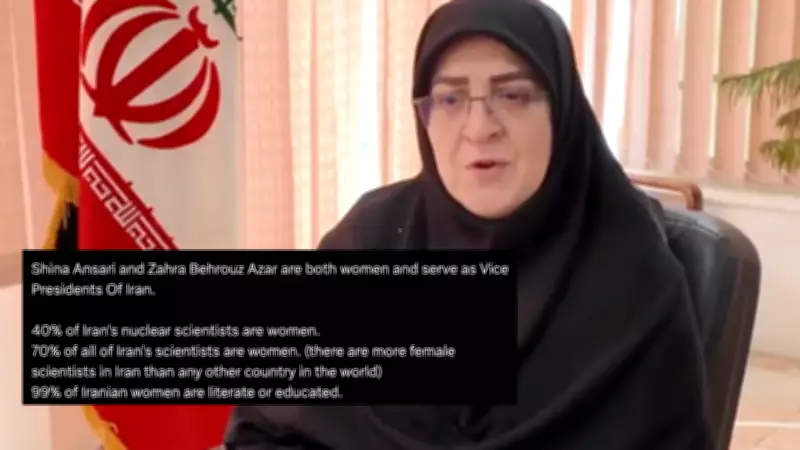
As footage of celebrating women circulated, critics of Western intervention pushed back with an alternative narrative about women's status in Iran. One widely shared social media post highlighted several achievements:
- Fatemeh Mohajerani serves as the official government spokesperson
- Shina Ansari and Zahra Behrouz Azar both hold vice presidential positions
- 40% of Iran's nuclear scientists are reportedly women
- 70% of all Iranian scientists are claimed to be women
- 99% of Iranian women are literate or educated
The implication was clear: the Western narrative of "liberating" Iranian women represents propaganda rather than reality. Commenters echoed this sentiment, with one writing, "Everything they told you about Iran is false. Make your own research, find your own truth," while another argued that Western concerns primarily focus on hijab usage rather than substantive oppression.
Fact-Checking the Claims
Examining these assertions reveals a more nuanced picture. Fatemeh Mohajerani indeed became Iran's first female government spokesperson in August 2024. However, women remain dramatically underrepresented in Iran's political system, holding fewer than 6% of parliamentary seats in the 290-member body. No woman has ever served as president or occupied the highest clerical offices.
The vice presidential appointments are accurate but contextual: Zahra Behrouz Azar oversees women and family affairs—a portfolio traditionally aligned with gendered social governance rather than executive parity.
The claim about women comprising 40% of nuclear scientists traces back to remarks reported by state-funded Press TV, with no independent verification available. Similarly, the 70% figure for all scientists lacks confirmation from international databases.
The literacy statistics, however, reflect measurable progress. According to World Bank and UNESCO data, adult female literacy in Iran has soared from approximately 35% in 1976 to about 85% by 2023—surpassing the Middle East and North Africa regional average of 67%. Iranian women now dominate university classrooms in many fields and are highly visible in medicine, engineering, and academia.

The Contradiction: Education Without Autonomy
This creates a striking contradiction: Iran promotes women's education and appoints women to visible administrative roles while maintaining strict ideological boundaries that limit autonomy. The constitution mandates that the Supreme Leader must be a male cleric, while presidential candidates must come from "rijal"—interpreted as religious men, effectively disqualifying female candidates.
Mandatory hijab laws remain enforced through morality policing, with the 2024 "Chastity and Hijab" legislation expanding penalties to include vehicle seizures and social media restrictions. The 2022 death of Mahsa Amini while in morality police custody ignited the "Woman, Life, Freedom" protests, which were met with violent suppression.
Family law maintains significant inequalities: men may unilaterally divorce while women face strict legal thresholds, often risking custody loss or financial support. Husbands can restrict wives' travel by withholding passport permission, and Article 1117 allows husbands to ban wives from employment deemed "incompatible" with family interests. Girls may legally marry from age nine with judicial approval.
State-Defined Feminism Versus Independent Activism
The Iranian establishment routinely frames demands for gender equality as foreign infiltration rather than domestic dissent, creating tension between state-defined roles for women and independent activism. This conflict has surfaced repeatedly throughout Iran's modern history:
- 1979 International Women's Day Protests: Tens of thousands demonstrated against early indications of mandatory Islamic dress, leading to formal hijab codification by 1983.
- 2009 Green Movement: Women played visible roles in protests following Mahmoud Ahmadinejad's disputed re-election, facing mass arrests and documented abuses.
- 2017-2019 Hijab Defiance: The "Girls of Revolution Street" movement saw women publicly removing headscarves, followed by the "Bloody November" protests where hundreds were killed.
- 2022 Mahsa Amini Protests: The death of 22-year-old Mahsa (Jina) Amini in morality police custody sparked nationwide "Woman, Life, Freedom" demonstrations resulting in hundreds of deaths and thousands of arrests.
Two Simultaneous Realities
Two factual realities coexist in contemporary Iran. Women do hold senior government positions as vice presidents, parliament members, professors, scientists, and doctors. Female literacy rates are genuinely high, and women comprise a significant share of university graduates and research professionals.
Simultaneously, compulsory hijab remains law with opposition leading to arrests, imprisonment, and lethal force. Protest movements across decades have resulted in mass detentions, with activists like Nobel laureate Narges Mohammadi remaining imprisoned for their advocacy.
Holding office in Iran does not automatically mean advocating for liberal feminist reform as understood in Western political discourse. Public officials operate within the ideological framework of the Islamic Republic, where advancement generally requires alignment with its constitutional and religious foundations. This creates the complex reality where educational and professional achievements exist alongside systemic restrictions on fundamental rights and freedoms.