

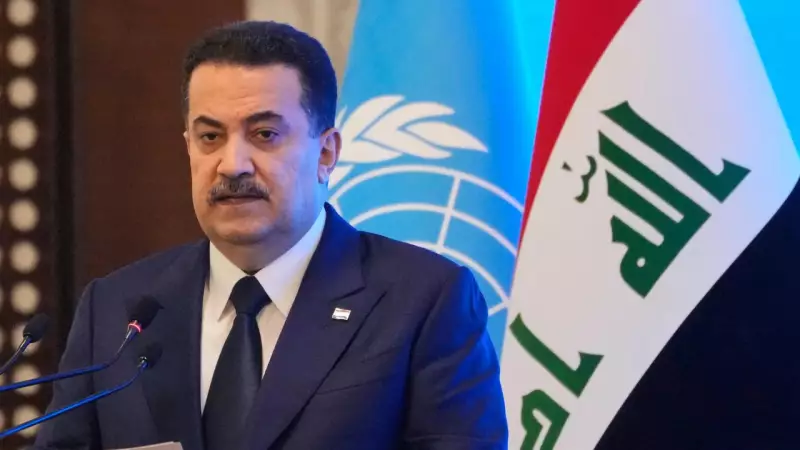
More than a month after Iraqis cast their votes, the nation finds itself in a familiar state of political paralysis. The November parliamentary elections failed to deliver a clear winner, plunging the country into protracted negotiations and leaving it without a new government. The deeply fragmented political landscape means that forming a ruling coalition will require complex alliances and difficult compromises.
A Fragmented Parliament and the Prime Minister's Challenge
According to the final results released by Iraq's election commission, Prime Minister Mohammed Shia al-Sudani's Reconstruction and Development Coalition emerged as the largest single bloc. It secured 46 seats in the 329-member parliament. However, this is far from the majority needed to govern alone.
Other key players include the Sunni party Taqaddum with 27 seats, former Prime Minister Nouri al-Maliki's State of Law alliance with 29 seats, and the Kurdistan Democratic Party with 26 seats. The overall voter turnout was recorded at 56.11 per cent.

Despite leading the poll, Al-Sudani's path to a second term is fraught with obstacles. His list must rely on the Shi'ite Coordination Framework, a powerful alliance of largely Iran-aligned parties that collectively dominates parliament. Analysts indicate that the Framework is hesitant to back Al-Sudani again, viewing him as having grown too independent and ambitious during his tenure.
"They want a prime minister they can manage," said Iraqi political analyst Sajad Jiyad, drawing parallels with the experience of Nouri al-Maliki, whose consolidation of power alienated rivals. Jiyad noted that Al-Sudani has transformed into "a powerful competitor" since taking office in 2022. It is noteworthy that no Iraqi prime minister other than al-Maliki has served two full terms since 2003.
Navigating Geopolitical Pressures and Armed Factions
The next administration will inherit one of Iraq's most sensitive dilemmas: the role of Iran-backed armed groups that hold parliamentary seats and wield significant influence on the ground. Washington has explicitly demanded these factions be excluded from government and ultimately dismantled, warning that militias loyal to Iran are incompatible with a strong US-Iraq partnership.
Several of these groups are part of the Popular Mobilisation Forces (PMF), which are formally under state control but operate with considerable autonomy. The group Asaib Ahl al-Haq, led by Qais al-Khazali, won 27 seats, making it a formidable force that cannot be easily sidelined. Other US-designated groups like Kataib Hezbollah support smaller blocs and have outright rejected any talk of disarmament.
Iraq has long performed a delicate balancing act between the United States and Iran, but the pressure is now intensifying. US officials have cautioned against appointing any prime minister who controls an armed faction or allowing militia-linked figures to run key ministries. Conversely, Iran is unlikely to accept any move that significantly weakens its allies in Baghdad.
Economic Stakes and the Road Ahead
Beyond the geopolitical tightrope, the incoming government will face immense economic challenges. Public debt exceeds 90 trillion Iraqi dinars, and the state budget relies on oil for roughly 90% of its revenue, highlighting a fragile and undiversified economy. Entrenched corruption continues to be a major impediment to growth.
Recent sanctions on Iraqi banks accused of helping Iran evade international restrictions have underscored the risks of economic isolation. Despite these challenges, Iraq has maintained relative stability amid regional turmoil, largely avoiding the direct fallout from the Gaza war that has affected other parts of the Middle East. Maintaining this precarious balance will be crucial for the next leadership.
While parliamentary procedures set a constitutional timetable for electing a speaker, president, and prime minister, few observers expect a swift resolution. As negotiations drag on, Iraq's political class must decide whether compromise can deliver a broadly acceptable government, or whether factional rivalry and the unresolved status of armed groups will prolong political uncertainty well into the new year.






