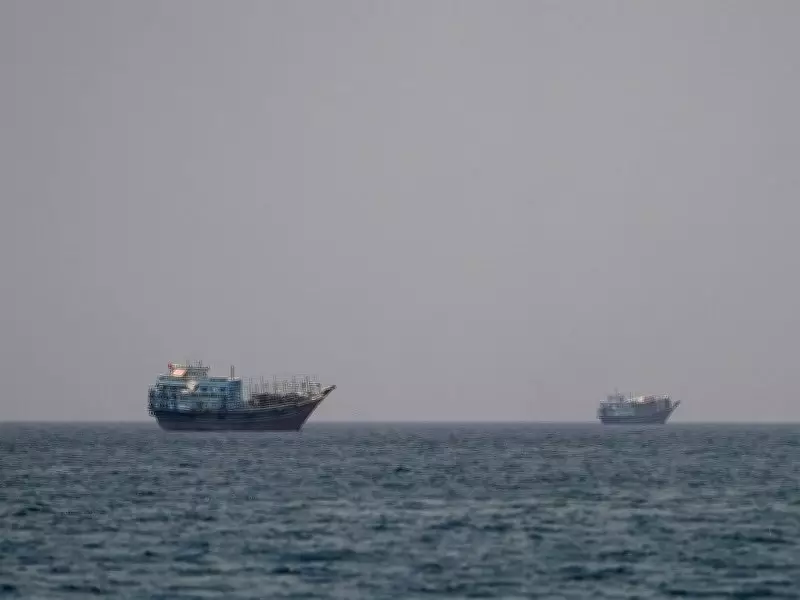
Qatar has strongly condemned the targeting of its vessel 'Al-Rekayyat' while it was transiting near the Strait of Hormuz on Monday night, describing the incident as an unacceptable attack on international maritime navigation and global energy security. In a post on X on Tuesday, Majed Al Ansari, Advisor to the Prime Minister and official spokesperson for Qatar's Ministry of Foreign Affairs, stated that the targeting constitutes a grave and explicit violation of international law, particularly the rules guaranteeing freedom of navigation and safe passage through international waterways.
Qatar's Official Condemnation and Demand for Accountability
Al Ansari demanded that Iran immediately cease all practices that undermine regional security or threaten the safety of international maritime navigation. He further asserted that Qatar would hold Iran fully legally responsible for the attack and for any resulting damages and consequences. The statement emphasized that the attack was an unacceptable assault on the security of global energy supplies and regional stability.
Iran's State Media Report on the Incident
Iran's state broadcaster IRIB, citing unnamed sources, reported that the Qatari oil tanker Al-Rekayyat was targeted after allegedly attempting to transit through the Omani route in the Strait of Hormuz with US Navy support while ignoring repeated Iranian warnings. IRIB highlighted Iran's longstanding position that the situation in the Strait of Hormuz will not return to what it was before the US attack on Iran, adding that all transit through the Strait must follow routes announced by Iran, otherwise the security of vessels cannot be guaranteed.

US Central Command Confirms Counter-Offensives
US Central Command (CENTCOM) confirmed on Tuesday that it executed a series of counter-offensives on July 7, striking more than 80 military positions inside Iran with precision-guided munitions. According to US defence officials, these targeted operations focused heavily on dismantling Tehran's maritime offensive capabilities. The targets neutralised during the multi-hour operation included command-and-control networks, air defence mechanisms, coastal radar installations, anti-ship missile sites, and more than 60 Islamic Revolutionary Guard Corps (IRGC) small boats.
Reason for US Military Response
CENTCOM detailed that the American military response was triggered by targeted acts of aggression against three commercial tankers transiting the waterway. The ships caught in the hostilities were identified as the Marshall Islands-flagged M/T Al Rekayyat, the Saudi Arabia-flagged M/T Wedyan, and the Liberian-flagged M/T Cyprus Prosperity. CENTCOM stated that the US strikes were in response to Iranian attacks on these three commercial vessels, calling Iran's aggression unwarranted, dangerous, and a clear violation of the ceasefire.
Explosions and Impact in Iranian Port Cities
Following the bombardments, Iranian state media reported multiple explosions in the port cities of Bandar Abbas and Sirik, as well as blasts on Qeshm Island. The state media also reported fires breaking out at the Sirik pier and the Shahid Haqqani Port in Bandar Abbas. Iran's official news agency IRNA, citing the office of the Governor of Hormozgan province, reported that to date, there have been no civilian casualty reports resulting from Tuesday evening's attacks by the American adversary.
Iranian Political Response
In a post on X, Iranian Parliament Speaker Ghalibaf enumerated several major violations of the Memorandum of Understanding (MoU) committed by the US administration, indicating a severe breakdown in diplomatic commitments. He issued a firm warning against Washington's hardline approach and asserted Tehran's refusal to back down under intense military and economic pressure. Ghalibaf concluded his statement on a defiant note: 'The era of bullying and extortion is over. It leads nowhere. We don't fold.'

Context of the Attack
This latest deployment marks the first direct American kinetic action targeting Iran since late June, when a brief cycle of intense strikes and counter-strikes culminated in a temporary cessation of hostilities under a bilateral Memorandum of Understanding. The US defence establishment asserted that the primary objective of the massive operation was to systematically degrade Tehran's capacity to launch further disruptions against merchant shipping in the economic corridor.