

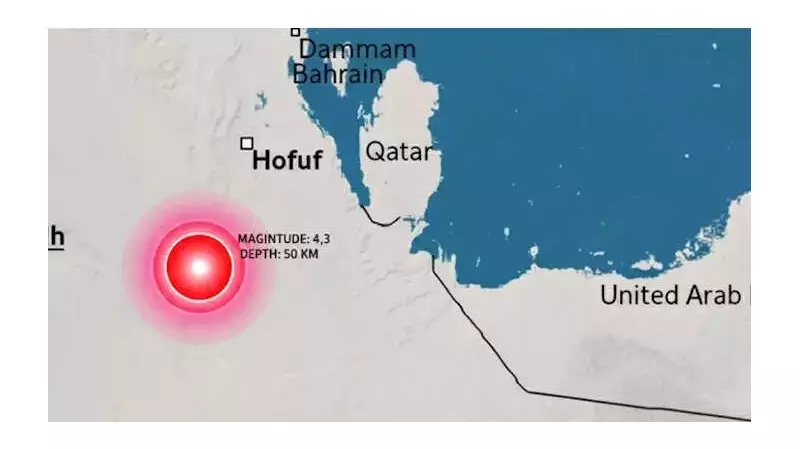
Residents of Saudi Arabia's Eastern Province were awakened in the early hours of Wednesday by the tremors of a moderate earthquake. The seismic event, which rippled through the region, was strong enough to be registered by monitoring stations but ultimately left the community and surrounding areas unscathed.
Details of the Seismic Event
The ground shook at 2:11 am UAE time on Wednesday, December 17, 2025. According to data released by the UAE's National Centre of Meteorology (NCM) and corroborated by Saudi authorities, the earthquake measured a magnitude of 4.3 on the Richter scale. The tremor originated from a depth of approximately 50 kilometers beneath the surface.
Seismologists classify this strength as a moderate earthquake. Such events are clearly recorded by sensitive instruments but typically do not lead to significant destruction at ground level. The epicenter was located within the Eastern Province of Saudi Arabia, a key region bordering the Arabian Gulf.

Impact and Official Reassurances
Following the tremor, Saudi authorities moved swiftly to allay any public concerns. The Saudi Geological Survey (SGS) and regional weather centers confirmed a series of positive outcomes from the incident.
No injuries or casualties were reported in the aftermath. Furthermore, inspections revealed no structural damage to buildings or critical infrastructure. The impact was contained, with neighboring nations like the United Arab Emirates reporting no effects. The UAE's NCM explicitly stated that their residents did not feel the quake and that it posed no risk to their coastal areas.
The Geological Context and a Pattern of Activity
While not famed for intense seismic activity, the Arabian Peninsula experiences occasional tremors due to its position on the Arabian Tectonic Plate. This plate is in constant, slow motion, pushing against adjacent plates like the Eurasian Plate. The resulting stress along fault lines sometimes releases as minor earthquakes.
This recent event is part of a documented pattern of minor seismic adjustments in the region throughout the year. It marks the fourth notable tremor in or near Saudi Arabia in 2025:
- April 2025: A magnitude 4.0 quake occurred 55 km east of Jubail.
- July 2025: A stronger magnitude 5.1 tremor was recorded near the Farasan Islands.
- October 2025: A magnitude 4.34 quake hit the Arabian Gulf, northeast of Khafji.
- December 2025: The current magnitude 4.3 event in the Eastern Province.
Geologists explain that these frequent, low-intensity events act as natural "pressure releases". By dissipating accumulated energy gradually, they may help prevent the buildup of stress that could lead to a more powerful and destructive earthquake in the future.
Experts from the Saudi Geological Survey emphasize that the Kingdom's National Seismic Monitoring Network operates continuously, tracking even the slightest movements in the earth's crust. This system ensures real-time data is available to assess any potential threats promptly.
For the people of the Eastern Province, the earthquake served as a gentle reminder of the dynamic planet beneath their feet. However, with no damage and life quickly returning to normal, the event underscores that such monitored, minor tremors are a routine part of the region's geology.






